
Krakow is the best-value major city in Central Europe by a significant margin — a medieval Old Town that survived World War II almost entirely intact, a royal castle that rivals Prague’s for grandeur, a Jewish quarter full of excellent restaurants, and an Auschwitz day trip that provides some of the most historically essential hours any traveler will spend in Europe. Krakow budget travel works because the city’s most compelling experiences — the Rynek Główny (one of Europe’s largest medieval squares), Wawel Castle’s exterior courtyard, the salt mine at Wieliczka, the Kazimierz neighborhood’s cafés and bars — are either free or deeply affordable. This Krakow budget travel guide gives you the complete framework: what to see, where to eat, where to stay, and how to cover everything for under €50/day.
At a Glance
| Country | Poland |
| Currency | Polish Zloty (PLN) — ~4 PLN per $1 USD / ~4.3 PLN per €1 EUR |
| Language | Polish; English widely spoken in tourist areas |
| Best time to visit | May–June, September–October (mild, fewer crowds than summer) |
| Avoid | July–August (peak prices, maximum crowds); January–February (cold, limited daylight) |
| Daily budget (frugal) | €30–€45/day |
| Daily budget (comfortable) | €60–€100/day |
| Visa | Schengen visa-free for US, UK, and most Western nationalities (90 days) |
| Airport | Kraków John Paul II International (KRK) — 15 km from Old Town, ~40 min by bus |
| Getting around | Walking (Old Town), tram (outer neighborhoods) |
Why Krakow Budget Travel Punches Above Its Weight
Krakow budget travel is effective for three intersecting reasons: the Polish Zloty remains undervalued relative to the Euro and Dollar, the concentration of free attractions is unusually high even by European standards, and the accommodation market — from party hostels to excellent mid-range hotels — has kept prices competitive despite growing tourism. A three-course dinner with wine at a good Polish restaurant costs €12–€18. A hostel bed in a well-reviewed Old Town property costs €12–€20. A single tram journey: PLN 6 (€1.40). For visitors from Western Europe or North America, Krakow budget travel means you are functionally twice as wealthy as you are at home — and the city’s quality of historic environment justifies every hour spent here.
Top Free and Low-Cost Sights
Rynek Główny (Main Market Square) — Free
Europe’s largest medieval market square — 200m × 200m — is the organizing center of Krakow’s Old Town and the place that makes Krakow budget travel visitors feel immediately that they made the right choice. The central Sukiennice (Cloth Hall, 14th century) houses a gallery level with Polish Romantic paintings (PLN 15 / €3.50 suggested donation; ground floor is free). St. Mary’s Basilica (14th century) on the square’s corner charges PLN 15 (€3.50) entry — the gold Gothic interior with the 15th-century Veit Stoss altarpiece is worth it. The famous Hejnał trumpet call plays from the taller of the basilica’s two towers every hour, breaking off mid-phrase — a tradition dating to a 13th-century Mongol attack.
Wawel Castle and Cathedral — Partially Free
Krakow’s royal castle sits on a limestone hill above the Vistula River — the seat of Polish kings from the 11th to 17th centuries. The exterior courtyard (free to enter) contains one of the finest Renaissance courtyards in Central Europe. Paid attractions inside include the State Rooms and Royal Private Apartments (PLN 35 each / €8.14); the Cathedral (PLN 17 / €3.95) with royal tombs dating back to the 14th century; and the Dragon’s Den cave (PLN 9 / €2.09). For Krakow budget travel visitors, the courtyard alone justifies the walk — interior tickets are worth it for at least the Cathedral.
Kazimierz — The Jewish Quarter — Free
Krakow’s medieval Jewish district — home to a Jewish community from the 14th century until the Holocaust deportations of 1941–1942 — is one of the most atmospheric and culturally dense neighborhoods in Poland. Seven historic synagogues remain, with the oldest (the Alte Schul / Old Synagogue, 15th century) now a museum (PLN 19 / €4.42). The Kazimierz Remuh Cemetery (PLN 10 / €2.33) is one of the best-preserved Renaissance Jewish cemeteries in Europe. Beyond the history, Kazimierz has the best independent café and restaurant scene in Krakow — the main square (Plac Nowy) hosts a daily food market with cheap zapiekanka (open-faced toasted baguettes with toppings, PLN 10–15 / €2.33–€3.49).
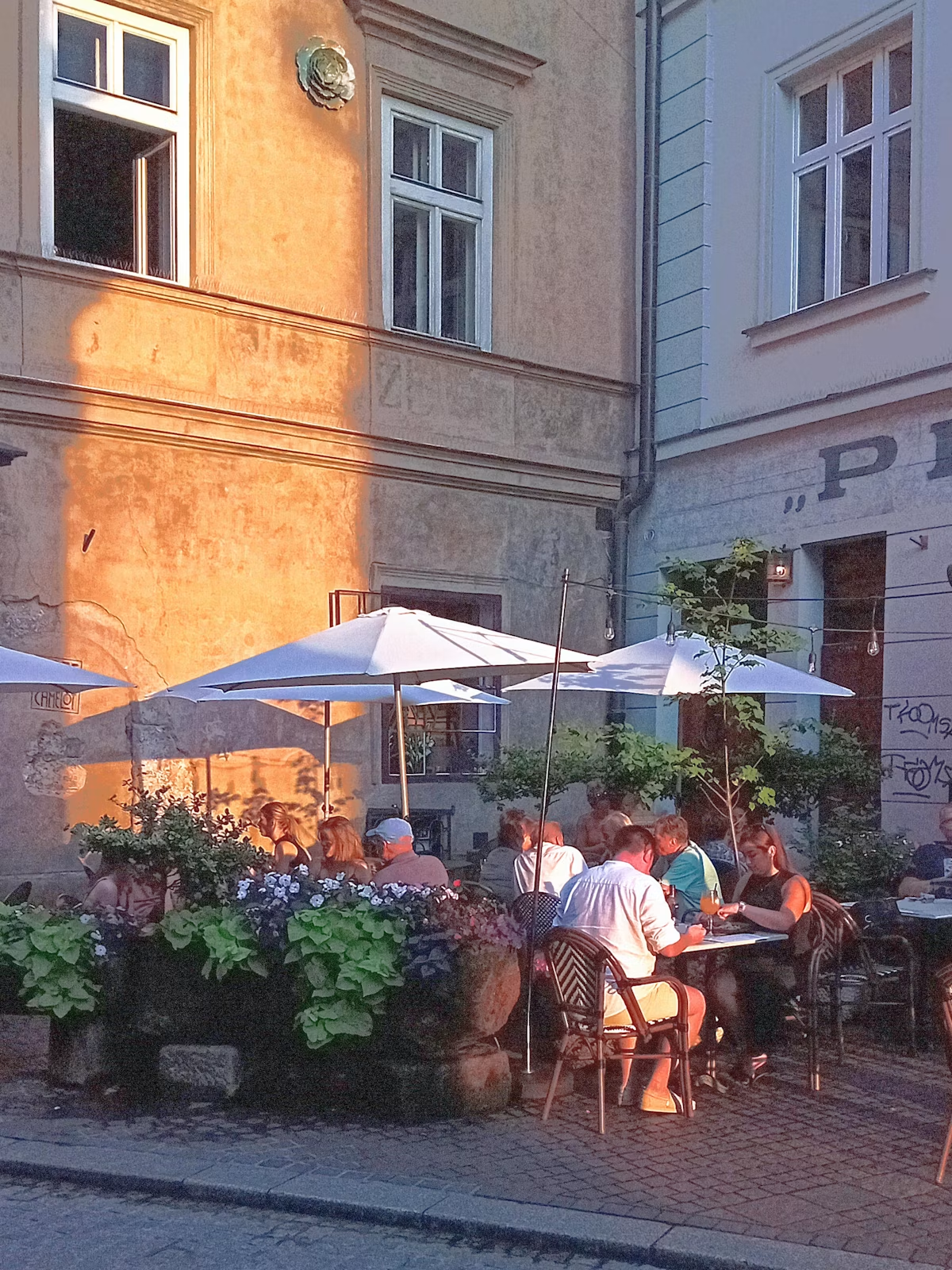
Photo by Aga Silva on Unsplash
Planty Park (the Old Town Ring) — Free
A green ring of parkland encircling the Old Town on the line of the medieval city walls — perfect for a morning walk that reveals the shape and scale of historic Krakow. The Barbican (northern gateway, PLN 15) and Floriańska Gate with a section of medieval wall (PLN 15) are the most photogenic points.
The Auschwitz Day Trip: Essential Krakow Budget Travel Context
No Krakow budget travel itinerary is complete without acknowledging the Auschwitz-Birkenau Memorial and Museum, located 70 km west of Krakow. This is one of the most morally essential visits in Europe — the preserved main camp (Auschwitz I) and the vast Birkenau site (Auschwitz II, where the majority of killings occurred) together form a UNESCO World Heritage Site visited by 2+ million people annually.
Practical details:
- Entry: Free (booking required — tickets at auschwitz.org)
- Guided tour: PLN 75 ($17.44 / €17.44) recommended; self-guided requires early booking
- Transport from Krakow: Oświęcim-bound bus or train from Dworzec Główny (Main Station) — ~1.5 hours, PLN 15–20 ($3.49–4.65 / €3.49–4.65). Or book a minibus transfer from Krakow operators (~PLN 50–80 return / €11.63–18.60)
- Allow 3–4 hours minimum; a full day is appropriate
This Krakow budget travel guide’s note: The Auschwitz-Birkenau Memorial is not a tourist attraction in the conventional sense. It should be approached with research and reflection beforehand. English-language guided tours provide essential historical context.
Wieliczka Salt Mine Day Trip
A UNESCO World Heritage Site 14 km southeast of Krakow — an underground salt mining complex operating since the 13th century, with carved salt chapels, statues, and crystalline underground lakes at depths of 64–135 m. The Cathedral Chapel of St. Kinga (built entirely from carved salt, 54 m long) is one of the most unexpected spaces in Europe.
- Entry + guided tour: PLN 119 (€27.67) standard; PLN 99 (€23.02) reduced
- Getting there: Bus 304 from Krakow Dworzec Główny — 30 minutes, PLN 6 (€1.40). One of the best-value Krakow budget travel day trips available
Krakow Food Guide
Polish cuisine is built around hearty, warming food — pierogies, hunter’s stew, grilled meats — that suits Krakow’s Central European climate and aligns perfectly with Krakow budget travel priorities.
Essential dishes:
- Pierogi: Boiled or fried dumplings filled with potato and cheese (ruskie), meat, mushroom, or fruit (dessert). PLN 15–25 ($3.49–5.81) for a plate of 10 at a milk bar or restaurant — the definitive Krakow food experience
- Bigos (Hunter’s Stew): Sauerkraut, fresh cabbage, various meats, mushrooms, and wine — slow-cooked and deeply flavored. PLN 20–35 ($4.65–8.14) at traditional restaurants
- Zapiekanka: Toasted half-baguette with mushrooms, cheese, and various toppings — Krakow’s street food staple, available at Plac Nowy in Kazimierz for PLN 10–15 ($2.33–3.49)
- Żurek: Sour rye soup served in a bread bowl with hard-boiled egg and white sausage. PLN 18–28 ($4.19–6.51) — Poland’s most distinctive soup and an excellent Krakow budget travel lunch
Best eating strategy for Krakow budget travel: Milk bars (Bar Mleczny) — Soviet-era subsidized canteens that survived to become budget staples. A full three-course meal at a milk bar: PLN 20–35 ($4.65–8.14). The best in Krakow: Bar Mleczny Pod Temidą (ul. Grodzka) and Bar Mleczny U Babci Maliny.
Where to Stay for Krakow Budget Travel
Hostels (€12–€22/night dorm)
Krakow has one of Europe’s strongest hostel scenes — partly due to the stag-party tourism from the UK, but the quality extends well beyond party hostels. Greg & Tom Hostel (Old Town) and The Secret Garden Hostel (Kazimierz) both consistently receive top reviews for atmosphere and facilities.
Budget Hotels (€45–€75/night)
The Kazimierz neighborhood offers the best budget hotel value in Krakow — charming renovated townhouses with breakfast included at prices that would be impossible in the Old Town proper. Radisson Blu (Old Town) offers occasional deals at €80–€100.
Location Guidance
Old Town is the most convenient but priciest base. Kazimierz is the best balance for Krakow budget travel — 15-minute walk to the Rynek, excellent restaurant and café access, tram connections everywhere.
Getting Around Krakow
Walking: The Old Town and Kazimierz are entirely walkable — the distance from the Rynek to the Wawel is 10 minutes on foot; Rynek to Kazimierz center is 20 minutes. Most Krakow budget travel itineraries require almost no paid transport within the city.
Trams: Single journey PLN 6 ($1.40); 24-hour pass PLN 20 ($4.65). The tram network is comprehensive for reaching areas outside the medieval core.
Airport: Bus 208 or 252 from Krakow Główny (Main Station) takes 40 minutes, PLN 6 ($1.40) — one of the best airport-to-city connections in Europe for Krakow budget travel purposes. Taxi: ~PLN 60–80 ($13.95–18.60).
Daily Budget Breakdown
| Category | Budget | Mid-Range |
|---|---|---|
| Accommodation | €15 (hostel dorm) | €70 (budget hotel) |
| Food (3 meals + bar snack) | €14 | €35 |
| Transport | €3 (tram pass) | €5 |
| Attractions | €8 | €20 |
| Daily Total | ~€40 | ~€130 |
Final Verdict: Krakow Budget Travel in 2026
Krakow makes an unanswerable case for Central Europe as a destination. The Old Town is a genuinely extraordinary medieval environment that costs nothing to walk. The food is satisfying and cheap. The Kazimierz neighborhood provides evenings of real quality — good restaurants, craft beer bars, and an atmosphere that rewards slow exploration. And the Auschwitz day trip provides historical context that makes Krakow budget travel not just economically smart but intellectually irreplaceable. For visitors seeking maximum historical and cultural value per euro spent in 2026, Krakow is the strongest argument Europe makes.