
Cartagena de Indias is the most beautiful city in Colombia and one of the most visually extraordinary in Latin America — a 16th-century Spanish colonial walled city on the Caribbean coast, its streets a collision of color: bougainvillea cascading from balconies above pastel facades in yellow, pink, and coral, plazas anchored by Baroque churches and shaded by ceiba trees, and the 11-kilometer ring of fortified city walls that Spanish engineers built to hold off Francis Drake and other European pirates who spent the 17th century trying to take the richest port in the New World. This Cartagena travel guide covers the Walled City in detail, the neighborhoods beyond it, the Caribbean coast access, the food scene, and the practical logistics for visiting Colombia’s Caribbean crown jewel in 2026.
At a Glance
| Country | Colombia |
| Currency | Colombian Peso (COP) — ~4,100 COP per $1 USD |
| Language | Spanish; English limited outside hotels and tourist services |
| Best time | December–April (dry season; strong Caribbean sun, no rain) |
| Avoid | October–November (wettest months); May–June (transitional wet season) |
| Daily budget (frugal) | $35–$55/day |
| Daily budget (comfortable) | $80–$150/day |
| Visa | Visa-free entry for US, EU, UK, Canadian, and Australian passport holders (up to 90 days) |
| Getting there | Fly to Rafael Núñez International Airport (CTG) — 10 minutes from the Walled City by taxi ($5–$8) |
| Getting around | Walking (Walled City), taxi, motorbike taxi, golf cart (Islas del Rosario) |
The Walled City (Ciudad Amurallada)
The Walled City is the reason the Cartagena travel guide exists — a 2-square-kilometer UNESCO World Heritage Site of cobblestoned streets, colonial plazas, 16th–17th century churches, and the densest concentration of architectural color in the Caribbean. The walls themselves (Las Murallas) are 11 kilometers of stone rampart, up to 17 meters thick in places, built over 200 years and never successfully breached. Walking the walls at sunset — from Baluarte de Santo Domingo around to Puerta del Reloj — with the Caribbean on one side and the red tile roofs of the colonial city on the other is the quintessential Cartagena travel guide experience.
Key sites within the Walled City:
- Plaza de Bolívar: The main plaza of the Cartagena Walled City — a shaded square anchored by an equestrian statue of Simón Bolívar, surrounded by the Palace of the Inquisition (now a history museum, COP 25,000 / $6.10 entry), the Cathedral of Cartagena (free entry, ongoing restoration), and the Gold Museum (free). The best people-watching plaza in the city
- Plaza de Santo Domingo: The most photographed plaza in the Cartagena travel guide circuit — a smaller, more intimate square dominated by the Church and Convent of Santo Domingo (the oldest church in Cartagena, 16th century), with the famous reclining woman sculpture (La Gorda Gertrudis by Fernando Botero) that everyone photographs
- Puerta del Reloj (Clock Tower Gate): The main entrance to the Walled City from the commercial port area — a 1600s arch tower flanked by Baroque turrets. The visual anchor of the Walled City’s western face
- Baluarte de San Francisco Javier / Las Murallas: The wall ramparts are free to walk at any hour — best at sunset for the light and the views across the Caribbean. Local vendors sell fresh coconut and tropical fruit along the walls
A note on crowds: The Cartagena Walled City is genuinely crowded from 10 AM to 6 PM during peak tourist season (December–February, Semana Santa). The Cartagena travel guide strategy for experiencing the city at its most beautiful is to be out before 8 AM — the streets are empty, the light is extraordinary, and the heat has not yet arrived.
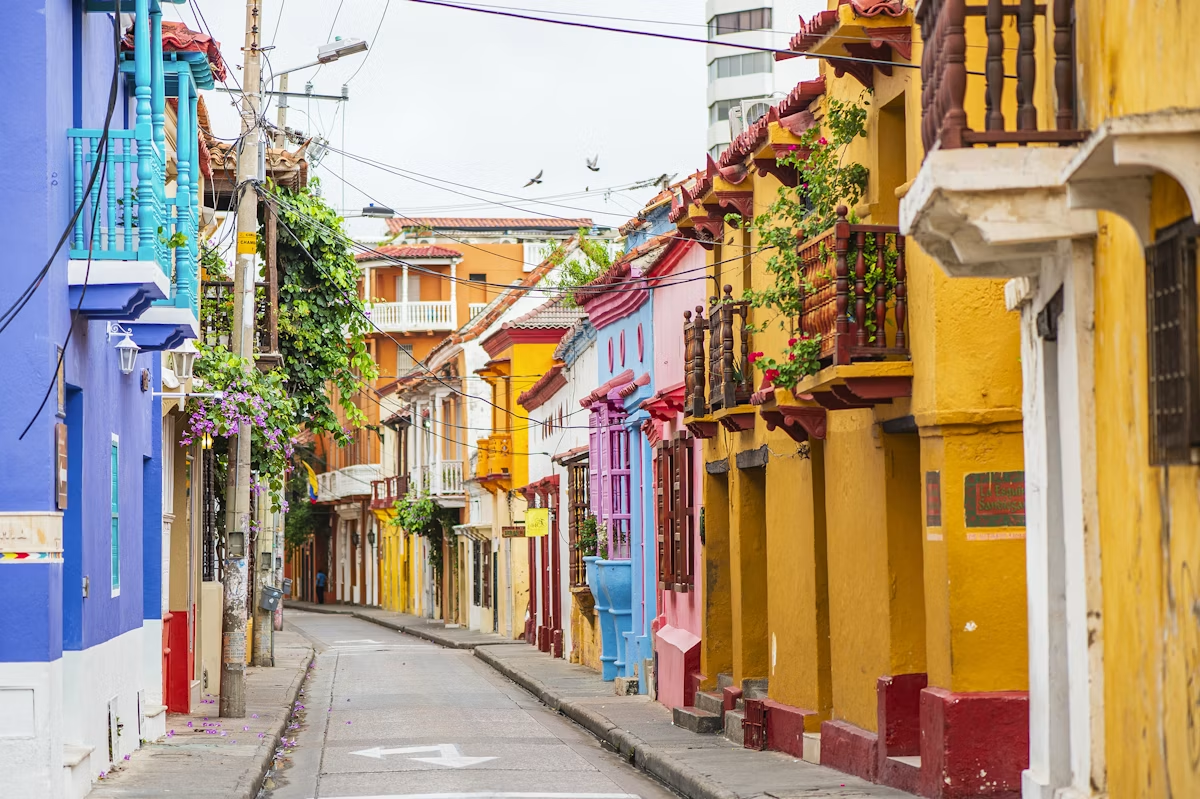
Photo by Ricky Beron on Unsplash
Castillo San Felipe de Barajas
The largest Spanish fortification in the Americas — a massive stone fortress built between 1536 and 1657 on the San Lázaro hill above the city, with a labyrinthine tunnel system designed for communication and surprise counter-attack. Entry: COP 35,000 ($8.54). The views from the upper terraces take in the full sweep of the Walled City, the Bocagrande beach district, and the Caribbean horizon. The Castillo San Felipe is the best single paid attraction in any Cartagena travel guide — allow 1.5 hours minimum, including the tunnel exploration.
Getsemaní — The Neighborhood Every Cartagena Travel Guide Now Covers
Immediately adjacent to the Walled City but outside the walls, Getsemaní was historically the poor, working-class neighborhood — where enslaved Africans, indigenous workers, and artisans lived, separated from the merchant elite within the walls. It is now the most culturally vibrant neighborhood in Cartagena — street murals of extraordinary quality cover the walls, the independent restaurant and bar scene is the best in the city, and the Plaza de la Trinidad at night (with locals playing dominoes, street food vendors, and live music) provides the most authentic Cartagena experience available.
The gentrification pressure is real — Getsemaní has been changing rapidly since 2015 — but the neighborhood character remains distinct from the tourist-polished Walled City. The Cartagena travel guide recommendation for accommodation is to stay in Getsemaní rather than the Walled City: prices are 30–50% lower and the walking distance to the historic center is under 10 minutes.
Bocagrande — The Beach District
Bocagrande is Cartagena’s modern beach district — a peninsula of high-rise hotels and apartment towers 2 km southwest of the Walled City, with a 3-kilometer urban beach strip. The water quality is modest (the beach is functional rather than beautiful compared to the islands offshore), but Bocagrande serves the Cartagena travel guide visitor who wants a beach walk, a coconut, and a swim within walking distance of the historic center.
Bocagrande practical info:
- Beach vendors sell fried fish, fresh coconuts, and chicha (local corn drink) along the shore — COP 5,000–15,000 ($1.22–$3.66)
- Sun lounger rental: COP 10,000–20,000 ($2.44–$4.88)
- Taxi from Walled City to Bocagrande: COP 8,000–12,000 ($1.95–$2.93)
Islas del Rosario: The Best Beach Day from Cartagena
For a genuine Caribbean beach day, the Cartagena travel guide directs visitors 45 km offshore to the Islas del Rosario — a coral archipelago of 27 islands in a National Natural Park, with white sand, turquoise water, and coral reef snorkeling accessible by day tour.
Logistics:
- Tours depart from the Muelle Turístico (Tourism Dock) near the Walled City from 8:00–8:30 AM
- Shared tour (includes 3-hour boat transit, lunch, and beach time): COP 70,000–100,000 ($17.07–$24.39) per person
- The tour stops at the Oceanario (aquarium, COP 25,000 extra) and typically one or two islands
- Private boat charter: COP 400,000–600,000 ($97.56–$146.34) for the whole boat
Playa Blanca (Barú Island): Accessible as a day trip without an organized tour — bus to Pasacaballos, then local boat across (COP 25,000 / $6.10 return). A wide, undeveloped beach with palm trees and seafood shacks. More physically accessible but less remote-feeling than the Islas del Rosario.
Colombian Food in Cartagena
Caribbean Colombian cuisine differs meaningfully from the Andean Colombian food of Bogotá and Medellín — more emphasis on coconut, tropical fruit, fresh seafood, and the African culinary influence of the coast.
Essential eating for any Cartagena travel guide:
- Ceviche de camarones: Shrimp ceviche in lime, tomato, and ají amarillo — a Caribbean version lighter and less acidic than Peruvian ceviche. COP 20,000–35,000 ($4.88–$8.54) from market stalls
- Arroz con coco: Coconut rice — a coastal staple, sweet-savory and fragrant. Served as an accompaniment to virtually everything. COP 5,000–8,000 ($1.22–$1.95) as a side
- Sancocho de gallina: Chicken soup with tropical root vegetables (yuca, plantain, corn on the cob) — the Colombian comfort dish. COP 12,000–20,000 ($2.93–$4.88) at local restaurants
- Empanadas costeñas: Coastal-style empanadas fried with egg and spiced meat filling — smaller and crispier than the Andean version. COP 1,500–3,000 ($0.37–$0.73) from street vendors
- Patacones: Twice-fried green plantain patties — served as a side, base for fish or chicken, or as a vehicle for coastal guacamole. COP 4,000–8,000 ($0.98–$1.95)
- Fried fish: Whole fresh Caribbean fish (pargo rojo, mojarra, or sierra) fried crispy and served with coconut rice, patacones, and a basic salad. The best version is found at the market stalls near La Boquilla fishing village or Mercado de Bazurto
Best Cartagena travel guide eating areas:
- Getsemaní: The best mid-range restaurant concentration — Demente, La Cevichería, and Beibi Getsemaní are the standout venues
- Mercado de Bazurto: The city’s main working market — raw and chaotic but the cheapest and most authentic costeño food in Cartagena. Not for the faint-hearted; go with a local or organized food tour (COP 80,000/$19.51)
- Walled City plazas: Premium pricing, tourist menus, but beautiful settings — justify the premium for one dinner
Day Trips from Cartagena
Palenque de San Basilio (75 km, 1.5 hrs)
The first free African town in the Americas — established in the early 17th century by escaped enslaved Africans led by Benkos Biohó, San Basilio de Palenque was recognized by Spain as an independent free territory in 1713. It is still inhabited and maintains the Palenquero language (the only Spanish-based creole in the Americas). UNESCO Intangible Heritage. Private tour with transport from Cartagena: COP 150,000–200,000 ($36.59–$48.78) per person. The most historically significant Cartagena travel guide day trip.
Mompox (3–4 hrs by bus and ferry)
A colonial river city on the Magdalena River — a UNESCO World Heritage Site of extraordinary quiet and intact Spanish colonial architecture, without the tourist infrastructure of Cartagena. Gabriel García Márquez drew on Mompox as a model for Macondo. Better as a 2-night trip than a day trip.
Where to Stay in Cartagena
Budget (COP 60,000–150,000 / $14.63–$36.59/night)
Getsemaní has the best budget accommodation selection — guesthouses, small hostels, and shared apartments at prices well below the Walled City. Che Lagarto Hostel and Mamallena Hostel are well-reviewed options in this range.
Mid-Range (COP 200,000–500,000 / $48.78–$121.95/night)
Boutique hotels in restored colonial buildings — both the Walled City and Getsemaní have excellent options. The boutique colonial hotel market in Cartagena is genuinely strong; properties like Casa Pombo (Walled City) and Casa Lola (Getsemaní) offer pool, air conditioning, and colonial architecture at mid-range prices.
Getting Around Cartagena
Walking: The Walled City is easily walkable in 20 minutes end-to-end. The core Cartagena travel guide circuit (Walled City + Getsemaní + Castillo San Felipe) is manageable on foot for fit visitors.
Taxi: Licensed yellow taxis are the standard for longer distances — Walled City to airport: COP 20,000–30,000 ($4.88–$7.32). Intra-city: COP 8,000–15,000 ($1.95–$3.66). Do not use unmarked taxis; use registered cabs or InDriver (local ride-hailing app).
Mototaxi: Ubiquitous and cheap for short distances outside the Walled City — COP 3,000–5,000 ($0.73–$1.22) per ride. Negotiate before boarding.
Daily Budget Breakdown
| Category | Budget | Comfortable |
|---|---|---|
| Accommodation | $20 (guesthouse) | $80 (boutique hotel) |
| Food (3 meals) | $12 | $35 |
| Transport | $4 | $12 |
| Activities / tours | $10 | $30 |
| Daily Total | ~$46 | ~$157 |
Final Verdict: Cartagena Travel Guide 2026
Cartagena earns its status as one of Latin America’s great travel destinations — the Walled City at dawn, the city walls at sunset, a dinner of coconut rice and fried fish in Getsemaní, a day among the turquoise water of the Islas del Rosario. This Cartagena travel guide recommends 3–4 days minimum: enough time to walk the city comprehensively, complete the Castillo San Felipe, do one island day, and spend an evening at the Plaza de la Trinidad when the neighborhood comes alive. Cartagena has become expensive by Colombian standards since its tourist surge — staying in Getsemaní, eating at local spots, and skipping the polished Walled City restaurants for neighborhood alternatives keeps the Cartagena travel guide budget under control without sacrificing experience.