
The Philippines is 7,641 islands, and the challenge of Philippines budget travel is not a lack of options but an embarrassment of them. Palawan has been voted the world’s best island more times than any other destination. Siargao is Southeast Asia’s most credible surf destination. Bohol has the Chocolate Hills and tarsiers. Cebu has the Kawasan Falls canyon canyoneering and Oslob whale sharks. The Batanes archipelago in the far north looks like something transported from the North Atlantic. Philippines budget travel is genuinely possible across all of these — a network of budget carriers (Cebu Pacific, AirAsia Philippines), a functional bus and ferry infrastructure, and accommodation markets that price aggressively against the regional competition mean that seeing significant portions of the archipelago on $35–$55/day is achievable with planning. This Philippines budget travel guide covers the key island destinations, island hopping logistics, the food culture, and a realistic breakdown of how to see the best of the Philippines without overspending.
At a Glance
| Country | Philippines |
| Currency | Philippine Peso (PHP) — ~57 PHP per $1 USD |
| Language | Filipino (Tagalog) and English — one of Asia’s most English-proficient countries |
| Best time | November–May (dry season); December–February optimal (dry, manageable heat) |
| Avoid | June–October (typhoon season; affects northern and eastern regions most) |
| Daily budget (frugal) | $25–$40/day |
| Daily budget (comfortable) | $55–$100/day |
| Visa | 30-day visa-free entry for most Western nationalities; extendable to 59 days at any Bureau of Immigration office for ~$70 |
| Getting there | Fly to Manila (MNL) or Cebu (CEB); domestic carriers connect to all island destinations |
| Getting around | Domestic flights (Cebu Pacific), buses, ferries, tricycles, jeepneys |
Why Philippines Budget Travel Works in 2026
The Philippines has several structural advantages for Philippines budget travel that distinguish it from more expensive island destinations in the region.
English: The Philippines has one of the highest English proficiency rates in Asia — navigating transportation, accommodation, and tour logistics is straightforwardly manageable without any local language knowledge.
Budget aviation: Cebu Pacific and AirAsia Philippines offer domestic fares as low as PHP 500–1,500 ($8.77–$26.32) on the busiest routes (Manila–Cebu, Manila–Caticlan/Boracay, Manila–Puerto Princesa/Palawan) when booked in advance. This makes island-hopping financially accessible in a way that slow boat travel cannot match for multi-island itineraries.
Accommodation: All major Philippines tourist destinations have a budget accommodation tier — fan rooms and budget air-con guesthouses ranging from PHP 500–900/night ($8.77–$15.79). Islands like Siquijor, Camiguin, and Batanes that receive fewer visitors have even lower accommodation floors.
Food: Filipino street food and local restaurant dining is among the most affordable in Southeast Asia — a full turo-turo (point-point) meal of rice with multiple ulam (viands) costs PHP 80–150 ($1.40–$2.63).
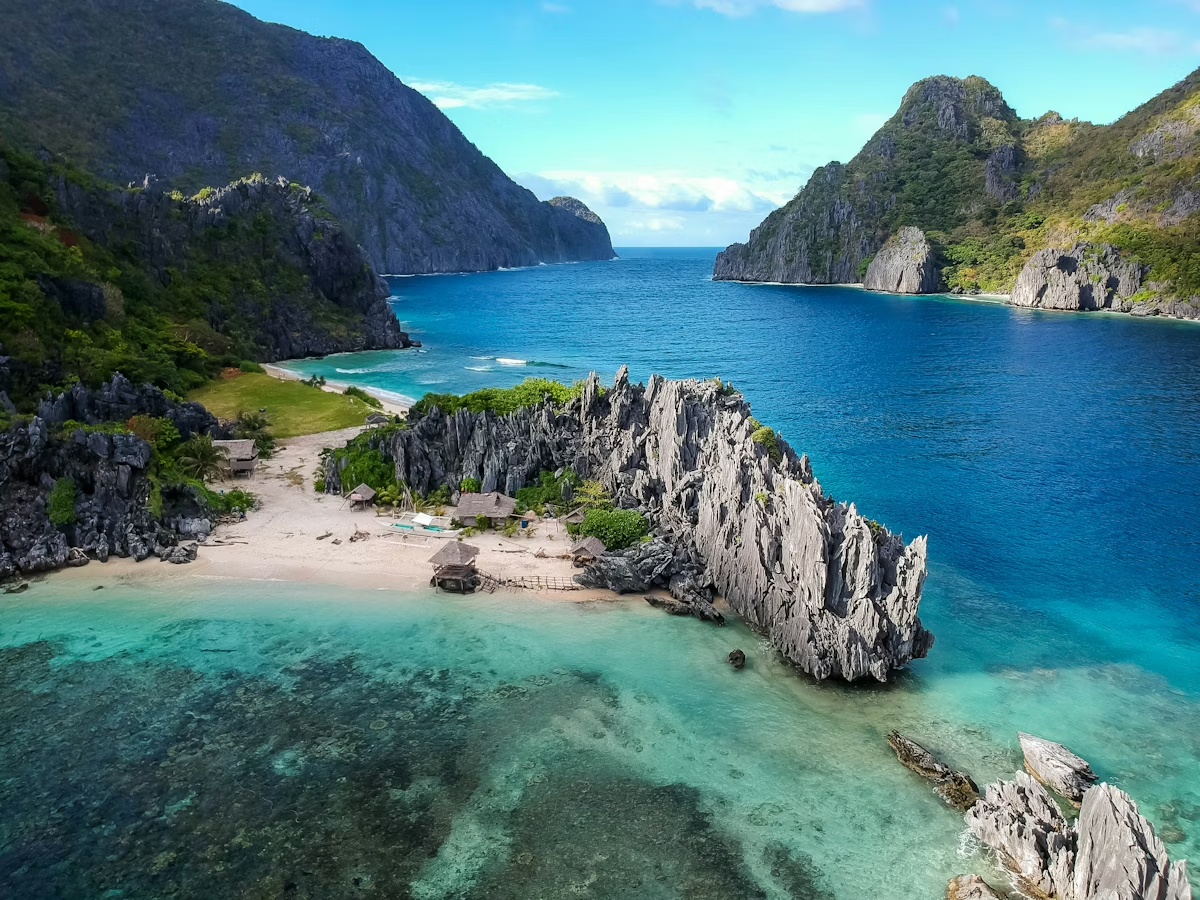
Photo by Cris Tagupa on Unsplash
Palawan: The Philippines Budget Travel Centerpiece
El Nido
El Nido is the most photographed destination in the Philippines — a cluster of limestone karst islands rising from turquoise water in northern Palawan, with hidden lagoons, white sand beaches, and snorkeling accessible only by bangka (outrigger boat). Island hopping tours from the town of El Nido cover four organized routes (A, B, C, D) with different sets of lagoons, beaches, and snorkeling spots.
Island hopping: Shared tour: PHP 1,500–2,000 ($26.32–$35.09) per person for a full-day tour including lunch. Private boat: PHP 4,500–7,000 ($78.95–$122.81) for the whole boat. The limestone-framed Big Lagoon (Tour A), the Cadlao Lagoon (Tour D), and the Twin Lagoon (Tour B) are the three unmissable stops.
Philippines budget travel in El Nido: Accommodation in the town center: PHP 600–1,200/night ($10.53–$21.05) for guesthouses with air conditioning. Restaurants in El Nido town: PHP 150–350 ($2.63–$6.14) per meal. The biggest cost is tours — budget accordingly.
Getting there: Fly Puerto Princesa → 5-hour bus north to El Nido (PHP 250 / $4.39), or fly directly to El Nido on small aircraft from Manila (Airswift, $80–$150 one-way — expensive but saves the bus).
Coron
Coron in northern Palawan is the Philippines’ best wreck diving destination — 24+ Japanese warships sunk by US aircraft in 1944 lie in the waters around Coron Island, accessible for diving and snorkeling from the town of Coron. The Barracuda Lake (thermocline snorkeling), Kayangan Lake (the most photographed lake in the Philippines), and the Twin Lagoon are the headline above-water attractions.
Philippines budget travel in Coron: Shared island hopping tours cover the lakes and lagoons — PHP 1,200–1,800 ($21.05–$31.58). Dive trips: PHP 1,800–2,500 ($31.58–$43.86) for a two-dive trip with equipment. Accommodation: PHP 700–1,400/night ($12.28–$24.56) at budget guesthouses.
Boracay: White Beach and Budget Strategies
Boracay’s White Beach — a 4-kilometer arc of fine white sand with exceptional water clarity — is the Philippines’ most internationally recognized beach destination, and one of the finest beach settings in Asia. It was temporarily closed in 2018 for environmental rehabilitation and has emerged cleaner and better regulated.
Philippines budget travel strategies for Boracay:
- Station 3 accommodation: The island’s southern end (Station 3) has the most affordable accommodation — beachfront budget rooms PHP 800–1,500/night ($14.04–$26.32) versus Station 1’s PHP 2,500+ for comparable locations
- DIY snorkeling: Rent a snorkel set (PHP 150/$2.63) and snorkel from the beach rather than taking organized boat tours
- Eat D’Mall side streets: The restaurants immediately behind White Beach near D’Mall are tourist-priced; the local food options on Boracay main road (Station 2 inland) serve the same dishes for 40–50% less
- Ferry and bus vs. fast craft: Getting to Boracay from Manila — flight to Kalibo + bus + ferry (PHP 1,200–1,800/$21.05–$31.58 total) versus flight to Caticlan + ferry (PHP 2,500–4,000/$43.86–$70.18)
The Visayas: Cebu, Bohol, and Siargao
Cebu — Philippines Budget Travel Gateway
Cebu City is the Philippines’ second city and a Philippines budget travel routing hub — the base for Kawasan Falls canyoneering (PHP 800–1,200/$14.04–$21.05), Oslob whale shark watching (PHP 1,000/$17.54 — controversial; the whale sharks are fed), and ferry connections to the rest of the Visayas.
Canyoneering to Kawasan Falls: A half-day adventure of cliff jumping, swimming through canyons, and rappelling into the blue pool at the base of Kawasan Falls. The most popular adventure activity in the Philippines for budget travelers.
Bohol
Connected from Cebu by fast ferry (PHP 250–550 / $4.39–$9.65, 2 hours), Bohol offers the Chocolate Hills (1,268 symmetrical mounds of limestone, best viewed from the Carmen viewpoint at sunrise), Philippine tarsiers at the Tarsier Conservation Area (PHP 60 / $1.05), and the Loboc River cruise (PHP 450 / $7.89 including buffet lunch). Panglao Island, connected by bridge, has some of the best dive sites in the Visayas.
Siargao — The Surf Island
Siargao’s Cloud 9 break is the Philippines’ most celebrated surf wave — a hollow right-hander breaking over a reef in the municipality of General Luna. Philippines budget travel works well in Siargao: board rentals from PHP 300 ($5.26)/day, surf lessons PHP 800–1,200 ($14.04–$21.05), and a well-established budget accommodation scene along the surfing district. The island’s lagoons (Sugba Lagoon, accessible by boat tour PHP 600–800/$10.53–$14.04) and the offshore islands of Daku, Guyam, and Naked Island are full-day trip material.
Manila: What to Know for Philippines Budget Travel
Manila is a required routing point for most Philippines itineraries — it handles the majority of international arrivals. It is not the most pleasant city in Southeast Asia, but it has cultural assets that reward a 1–2 day layover.
Worth seeing in Manila:
- Intramuros: The 16th-century Spanish walled city — Fort Santiago, the Manila Cathedral, Rizal Shrine. Entry free to stroll; Fort Santiago: PHP 75 ($1.32). A Bambike bicycle tour (PHP 600/$10.53) is the best orientation
- Binondo (Chinatown): The world’s oldest Chinatown, founded 1594 — dense, chaotic, and excellent for food. Siopao (steamed buns), hopia (bean paste pastries), and fresh dim sum from century-old vendors
- National Museum of the Philippines: Free entry; the permanent collection includes Juan Luna’s enormous Spoliarium (1884) — one of the great Philippine artworks
Philippines budget travel Manila accommodation: Makati and Ermita have the most budget accommodation options — PHP 600–1,000/night ($10.53–$17.54) at guesthouses.
Filipino Food: Philippines Budget Travel Eating Guide
Filipino food is built around rice — all three meals — supplemented by pork, fish, seafood, and a repertoire of souring agents (vinegar, tamarind, calamansi) that give the cuisine its distinctive character.
Essential dishes:
- Adobo: Pork or chicken braised in vinegar, soy sauce, garlic, and bay leaf — the Philippines’ most internationally recognized dish. PHP 80–150 ($1.40–$2.63) from turo-turo
- Sinigang: Tamarind-soured soup with pork, shrimp, or fish and vegetables — sour, savory, warming. PHP 90–200 ($1.58–$3.51) depending on protein
- Lechon: Whole roasted pig, crispy skin, with liver sauce — the centerpiece of Philippine feasts. Order lechon kawali (crisped pork belly) for a budget-friendly version at PHP 100–180 ($1.75–$3.16)
- Kare-Kare: Oxtail and vegetables in peanut sauce with shrimp paste — one of the most technically interesting Filipino dishes. PHP 150–300 ($2.63–$5.26) at local restaurants
- Halo-Halo: Mixed dessert of shaved ice, condensed milk, ube (purple yam), sweetened beans, leche flan, and jackfruit — the Philippine summer dessert. PHP 60–120 ($1.05–$2.11)
- Sisig: Crispy, sour pork face and liver with chili and calamansi — an Ángeles City creation now eaten everywhere. PHP 120–200 ($2.11–$3.51) as a drinking food
Getting Around the Philippines on a Budget
Domestic flights: The single most important Philippines budget travel tool. Cebu Pacific’s promotional fares (PHP 499–999 / $8.77–$17.54 for Manila to Cebu or Davao booked 2+ months ahead) make island-hopping across large distances financially viable.
Buses: Reliable for Luzon (Manila to Baguio, Manila to Vigan, Manila to Bicol). Philippine Rabbit and Victory Liner cover the main routes — PHP 200–800 ($3.51–$14.04) depending on distance.
Ferries: 2GO Travel and Cokaliong operate overnight and multi-day ferry routes between Manila, Cebu, Mindanao, and the Visayas. Slow but extremely cheap — Manila to Cebu: PHP 800–1,200 ($14.04–$21.05) for economy class, 21 hours.
Tricycles and jeepneys: Short-distance local transport — tricycles (motorbike sidecar) for PHP 15–50 ($0.26–$0.88) within towns; jeepneys for PHP 12–25 ($0.21–$0.44) in cities.
Daily Budget Breakdown
| Category | Budget | Comfortable |
|---|---|---|
| Accommodation | $12 (guesthouse) | $45 (beachfront hotel) |
| Food (3 meals) | $8 | $22 |
| Transport | $5 | $15 |
| Activities (island hopping, etc.) | $15 | $35 |
| Daily Total | ~$40 | ~$117 |
Note: Domestic flight costs are excluded — budget these separately as lump sums per leg.
Final Verdict: Philippines Budget Travel in 2026
The Philippines rewards the Philippines budget travel visitor who plans island routing in advance and books domestic flights early. The variable is not daily spending — that remains genuinely low by regional standards — but inter-island transport, which can spike significantly if flights are booked close to departure or if you rely on private speedboats. Palawan is non-negotiable for a first visit. The Visayas (Cebu, Bohol, Siargao) add breadth and adventure. And for Philippines budget travel visitors who want to escape the established circuit entirely, Batanes in the north, Camiguin in Mindanao, and Siquijor in the Visayas all offer exceptional quality at significantly lower tourist-inflated pricing. The archipelago is large enough to absorb months of travel — Philippines budget travel is not a compromise but a strategy.