
Siem Reap is the base for one of the great archaeological sites on Earth. The Angkor complex — a sprawling ensemble of Khmer temple cities built between the 9th and 15th centuries across 400 square kilometers of jungle and rice paddy — is genuinely unlike anything else in Southeast Asia. Angkor Wat alone, the largest religious monument ever built, is reason enough to make the journey. But the Angkor complex extends far beyond Angkor Wat: the walled city of Angkor Thom, the face towers of the Bayon, the jungle-consumed ruins of Ta Prohm, and dozens of smaller temple complexes that receive a fraction of the crowds. This Siem Reap travel guide covers the temple circuit in detail, the logistics of touring it efficiently, the town of Siem Reap itself, Cambodian food worth seeking out, and a realistic budget breakdown for 2026.
At a Glance
| Country | Cambodia |
| Currency | US Dollar (USD) widely used; Cambodian Riel (KHR) for small transactions — ~4,000 KHR per $1 |
| Language | Khmer; English widely spoken in tourist areas |
| Best time | November–March (dry season, 25–33°C, clear skies for temple photography) |
| Avoid | June–October (wet season; heavy afternoon rain, but crowds are lower) |
| Daily budget (frugal) | $20–$35/day |
| Daily budget (comfortable) | $55–$100/day |
| Visa | E-visa required for most nationalities — $36 online at evisa.gov.kh; valid 30 days |
| Getting there | Fly to Siem Reap International Airport (SAI, new terminal opened 2023); or bus from Bangkok (~8 hrs) |
| Getting around | Tuk-tuk, bicycle, rented scooter |
Angkor Pass: The Essential Purchase for Any Siem Reap Travel Guide
Every Siem Reap travel guide begins with the Angkor Archaeological Park pass — required for entry to all major temple sites and purchased at the official ticket center on the road to Angkor.
- 1-day pass: $37
- 3-day pass: $62 (valid on any 3 days within 10 days)
- 7-day pass: $72 (valid on any 7 days within 30 days)
The pass includes Angkor Wat, Angkor Thom, Bayon, Ta Prohm, Preah Khan, Banteay Srei, and all other monuments within the archaeological park. It does not include Beng Mealea or the remote temple complexes.
Siem Reap travel guide recommendation: The 3-day pass is the minimum for doing justice to the major sites. With a 7-day pass and longer stay, the complex reveals itself in layers — quieter sites, different light conditions, and the experience of returning to temples already visited at different times of day.
Angkor Wat: The Core of This Siem Reap Travel Guide
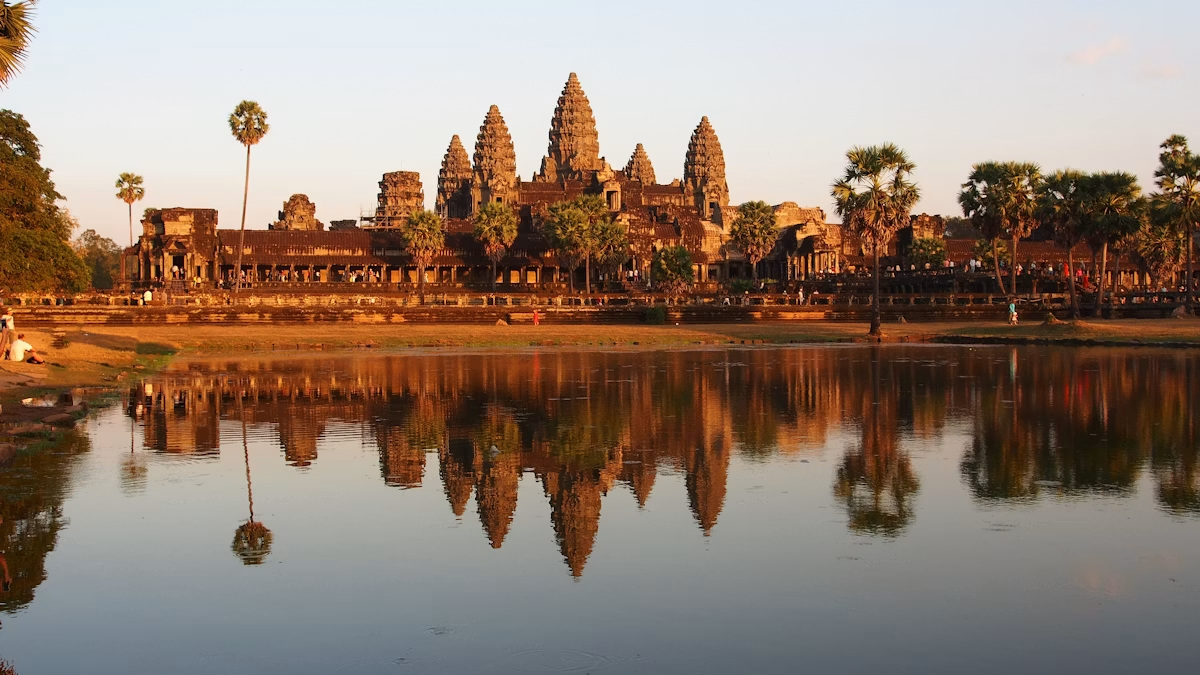
Angkor Wat was built by Khmer King Suryavarman II in the early 12th century as both a state temple and royal mausoleum — a sandstone mountain representing Mount Meru, the cosmic center of the Hindu universe. It covers 1.6 km² and is surrounded by a moat 200 meters wide. The western gopura (entrance tower) is 230 meters wide. The longest continuous bas-relief in the world — 800 meters of carved narrative depicting scenes from Hindu mythology and Khmer history — wraps the inner gallery walls.
Sunrise at Angkor Wat is the defining experience of any Siem Reap travel guide. Arriving before 5:30 AM, the reflection of the five towers in the reflecting pond in front of the western entrance, with the sky shifting through gray to gold — this is one of the great landscape experiences in Asia. The crowds are heavy at the main pond but thin considerably along the access causeway and the northern side of the moat.
Temple hours: Open 5:00 AM–6:00 PM daily. The inner sanctuary (the top level of the temple mountain) requires covering shoulders and knees — sarongs available at the gate.
Siem Reap travel guide logistics:
- Arrive before 5:30 AM for sunrise
- Allow 3–4 hours for a thorough visit
- Return in the late afternoon (4:00–6:00 PM) for dramatically different light and far thinner crowds
- The bas-reliefs are best viewed in the morning light on the eastern galleries
Angkor Thom and the Bayon
Angkor Thom — “Great City” in Khmer — is the last great capital of the Khmer Empire, built by King Jayavarman VII in the late 12th century. A walled city 3 km per side, surrounded by a moat and entered through five enormous stone gates, each topped with giant face towers. The south gate, with its flanking rows of gods and demons pulling a serpent in the mythological “Churning of the Ocean of Milk,” is the most photographed entrance in the complex.
At the center of Angkor Thom stands the Bayon — Jayavarman VII’s state temple, a mass of 54 towers carved with 216 giant faces (widely believed to represent the king himself as bodhisattva Avalokiteshvara). The Bayon is architecturally chaotic in a way that Angkor Wat is not — towers crowd each other at overlapping angles, faces emerge from stone at different scales. It rewards confusion. Allow 2 hours minimum; the best light is in the early morning.
Other Angkor Thom highlights: Baphuon (a 60-meter temple pyramid with a 9th-century reclining Buddha carved into its western face), Phimeanakas (royal palace temple), and the Elephant Terrace and Terrace of the Leper King along the Royal Square.
Ta Prohm and the Jungle Temples
Ta Prohm was built by Jayavarman VII in the late 12th century as a Buddhist monastery and university — at its peak, 12,640 people lived and worked within its walls. It was left deliberately unrestored after its 1990s rediscovery, so that the jungle growth that consumed it over 600 years of abandonment remains visible: strangler fig and silk-cotton trees have split corridors, toppled towers, and grown through stone roofs. The roots cascade down walls in shapes that have become iconic in photography.
The visual effect is extraordinary — and is the reason Ta Prohm features in essentially every Siem Reap travel guide ever written. It is the most atmospheric site in the complex after the Angkor Wat sunrise, and crowds thin significantly once visitors move beyond the main Instagram locations.
Other jungle temples worth including in a Siem Reap travel guide itinerary:
- Preah Khan: A large, mostly flat temple complex of long corridors and courtyards — less photogenic than Ta Prohm but significantly less crowded. The tree growth is dramatic at the eastern entrance
- Neak Pean: A 12th-century artificial island temple set in a square reservoir — surreal in the wet season when the water level rises
- Banteay Kdei: Immediately adjacent to the Srah Srang reflecting pool (good sunrise photography from the pool’s eastern bank)
Banteay Srei: The Pink Temple
Banteay Srei stands 37 km northeast of Angkor Wat and requires a half-day excursion, but it is one of the most remarkable structures in the entire Angkor complex. Built in the 10th century (predating Angkor Wat by 150 years), it is constructed of pink sandstone and decorated with some of the finest decorative carving in Khmer art — the intricate detail of the pediment scenes and pilaster carvings is staggering at close range.
Entry is included with the Angkor pass. Tuk-tuk from Siem Reap: approximately $20–$25 round trip with a 1–2 hour wait. The site is best visited mid-morning after Angkor Wat sunrise and before the midday heat.
Siem Reap Town
The town that serves the Angkor complex has transformed over the past two decades from a small provincial city to a developed tourist destination with excellent accommodation, restaurants, and nightlife. Pub Street and the Old Market (Psar Chas) area form the tourist core — lively, bar-dense, and increasingly international in character. The riverside area west of Old Market is quieter, with boutique hotels and restaurants in restored French colonial buildings.
The Artisans Angkor workshop (near the Grand Hotel) is worth visiting for context on Khmer craft traditions — a social enterprise training program for disadvantaged young Cambodians in silk weaving, stone carving, lacquerwork, and wood carving. Free entry; attached shop sells high-quality artisan products.
Cambodian Food in Siem Reap
Cambodian cuisine is Southeast Asia’s most underrated food culture — influenced by Thailand to the west, Vietnam to the east, and France from the colonial era, but with a distinct character built around freshwater fish, rice, aromatic herbs, and fermented ingredients.
Essential dishes for every Siem Reap travel guide:
- Amok Trey (Fish Amok): Cambodia’s national dish — fish steamed in banana leaf with a spiced coconut curry mousse, lemongrass, kaffir lime, and kroeung (Khmer spice paste). The texture is custard-like, the flavor subtle. $3–$8 at restaurants
- Bai Sach Chrouk: Pork and rice — thin slices of pork marinated in coconut milk and garlic, grilled slowly over coals, served with a bowl of pickled daikon and cucumber. The essential Cambodian breakfast. $2–$4 at morning market stalls
- Nom Banh Chok (Khmer Noodles): Fresh rice noodles in a fish-based green curry broth, topped with cucumber, banana blossom, bean sprouts, and fresh mint. Sold from baskets by women at morning markets — $1–$2/bowl
- Lok Lak: Stir-fried beef cubes in a sweet and savory sauce, served over rice or French bread with a lime-pepper dipping sauce and fried egg. The French-Khmer fusion plate. $4–$8
- Lap Khmer: Khmer-style beef salad with lemongrass, chili, lime, and fresh herbs — sharp, fragrant, served raw (beef carpaccio-style) or cooked. $5–$9
Best areas for eating in Siem Reap: The Old Market area has the highest restaurant density but tourist pricing. The local food markets (Psar Leu, Psar Kandal) serve Khmer food for market prices ($1–$2). Sok San Road has developed a cluster of mid-range Cambodian restaurants that balance quality and price well.
Day Trips from Siem Reap
Beng Mealea (65 km, 1.5 hrs)
A remote jungle temple roughly the same size as Angkor Wat — almost entirely unrestored and genuinely atmospheric in its ruined state. Trees grow through towers, corridors are blocked by collapsed stone, and the undergrowth has been only partially cleared. Entry: $5. The limited crowds (it’s outside the main Angkor pass) make this one of the best off-circuit experiences in any Siem Reap travel guide.
Tonlé Sap Lake (15 km, 30 mins)
The largest freshwater lake in Southeast Asia and a UNESCO Biosphere Reserve — a unique ecosystem where water levels rise by 9 meters between dry season and wet season, creating floating villages, inundated forests, and a fishing culture that has supported the Khmer civilization for millennia. Village boat tours: $10–$20. The floating village of Kampong Phluk (stilted houses in the dry season, floating houses in the wet) is the most visited.
Where to Stay in Siem Reap
Budget ($8–$20/night)
Siem Reap has one of the best budget accommodation markets in Southeast Asia — guesthouses on the streets near the Old Market area offering clean rooms with air conditioning, WiFi, and sometimes pool access at hostel prices. Mad Monkey Hostel and Onederz Hostel are well-reviewed at this price point.
Mid-Range ($35–$80/night)
The best value bracket in Siem Reap — boutique pool villas, garden guesthouses in converted Khmer houses, and small hotels in the riverfront area. Shinta Mani Wild and La Niche d’Angkor represent the top of this range. Many mid-range properties include breakfast and tuk-tuk transfers to the temples.
Getting Around Siem Reap
Tuk-tuk: The standard Siem Reap transport for temple touring — a contracted tuk-tuk driver for a full day costs $15–$25, covering the major circuits plus town transfers. Drivers wait outside the temples and are usually knowledgeable guides. Agree on the price before departure.
Bicycle: The small circuit (Angkor Wat, Angkor Thom, Ta Prohm) is cycleable in a day — flat terrain, quiet roads in the early morning. Rentals: $2–$5/day from guesthouses. Recommended for fit travelers with an early start in the cool season.
Scooter: $8–$12/day for a 100–125cc scooter — useful for independent exploration including remote temples. Most guesthouses rent without requiring an international license (check your travel insurance policy).
Daily Budget Breakdown
| Category | Budget | Comfortable |
|---|---|---|
| Accommodation | $10 (guesthouse) | $55 (boutique hotel) |
| Food (3 meals) | $8 | $25 |
| Angkor pass (per day) | $20 (3-day pass average) | $20 |
| Transport (tuk-tuk) | $5 | $20 |
| Activities / misc | $4 | $15 |
| Daily Total | ~$47 | ~$135 |
Note: Angkor pass cost dominates the budget — the 7-day pass ($72) reduces the per-day cost to $10.29 for longer stays.
Final Verdict: Siem Reap Travel Guide 2026
Angkor justifies the journey from anywhere in the world. The sunrise at Angkor Wat, the faces of the Bayon emerging from morning mist, the root-consumed corridors of Ta Prohm — these are not merely good photographs; they are experiences that alter how you understand the scale of human ambition and the power of time. The Siem Reap travel guide recommendation is 4–5 days minimum: enough for a thorough circuit of the major sites, the half-day Banteay Srei excursion, a morning on the Tonlé Sap, and the Angkor Wat sunrise properly done — meaning returning for it at least twice. The temples reward repetition, and the light at each hour genuinely transforms what you see.