
Oaxaca is Mexico’s food capital, its mezcal heartland, one of its richest archaeological regions, and arguably the country’s most culturally compelling destination for travelers who care about what they eat, where things come from, and how they are made. The city of Oaxaca de Juárez — the capital of Oaxaca state — is a UNESCO World Heritage Site of colonial architecture built on top of Zapotec and Mixtec civilization: the ruins of Monte Albán overlook the Oaxaca Valley from a flattened hilltop 400 meters above the city. The food here is not Mexican-restaurant-in-a-foreign-country Mexican food — it is some of the most specific, location-dependent cooking on Earth, where the seven moles, the tlayudas, the chapulines, and the mezcal are products of a particular soil and climate that cannot be replicated elsewhere. This Oaxaca travel guide covers the historic center, the archaeological sites, the food culture in detail, the mezcal scene, the textile markets, and the practical logistics for 2026.
At a Glance
| Country | Mexico |
| Currency | Mexican Peso (MXN) — ~18 MXN per $1 USD |
| Language | Spanish; indigenous languages (Zapotec, Mixtec) in rural areas; English in tourist areas |
| Best time | October–May (dry season); November and April–May optimal (mild, clear) |
| Special events | Día de los Muertos (Oct 31–Nov 2) — the most significant cultural event in any Oaxaca travel guide |
| Avoid | June–September (rainy season; afternoon storms, though the greenery is beautiful) |
| Daily budget (frugal) | $30–$50/day |
| Daily budget (comfortable) | $70–$130/day |
| Visa | Visa-free entry for US, EU, UK, Canadian, and Australian passport holders (180 days) |
| Getting there | Fly to Xoxocotlán International Airport (OAX) — 8 km from city center; or overnight bus from Mexico City (7 hrs) |
| Altitude | 1,550 meters — acclimatize before heavy activity |
The Historic Center: Starting Every Oaxaca Travel Guide Here
The historic center of Oaxaca de Juárez is a compact district of green-stone (cantera verde) churches, colonial facades, and tree-shaded plazas that rewards slow walking. The characteristic green volcanic stone — cantera verde — gives Oaxacan colonial architecture its distinctive color, visible nowhere else in Mexico at this scale.
Key sites in the historic center:
- Zócalo (Plaza de Armas): The main plaza — shaded by laurel trees, ringed by portales (arcaded walkways) with café terraces, and anchored by the Municipal Palace on the north and the Cathedral of Oaxaca on the east. The social center of Oaxacan life; political demonstrations, food vendors, marimba bands, and tourists coexist in a plaza that functions as a genuine public space. Free
- Cathedral of Oaxaca: A Baroque facade begun in 1535 and completed in its current form in the 18th century — the green cantera stone at its most dramatic. Free entry
- Templo de Santo Domingo de Guzmán: The finest colonial church in Oaxaca — a 16th–17th century Dominican church with an extraordinarily ornate gold-leaf interior that survived a century as a military barracks by being almost uniquely difficult to strip. The attached cultural museum (Centro Cultural Santo Domingo) covers Zapotec, Mixtec, and Oaxacan colonial history. Museum entry: MXN 85 ($4.72). The essential Oaxaca travel guide paid attraction in the city center
- Andador Macedonio Alcalá: The pedestrian street connecting the Zócalo to Santo Domingo — Oaxaca’s central promenade, lined with galleries, mezcal bars, textile shops, and restaurants. The best evening walking route in any Oaxaca travel guide
The Mercado Benito Juárez and Mercado 20 de Noviembre: Two adjacent markets one block from the Zócalo — the Juárez market for produce, cheese, chocolate, and crafts; the 20 de Noviembre market for prepared food. The corridor of charcoal-grilled meats (the pasillo de humo, “smoke alley”) in the 20 de Noviembre market is where to eat tlayudas and tasajo (thinly sliced, dried Oaxacan beef).
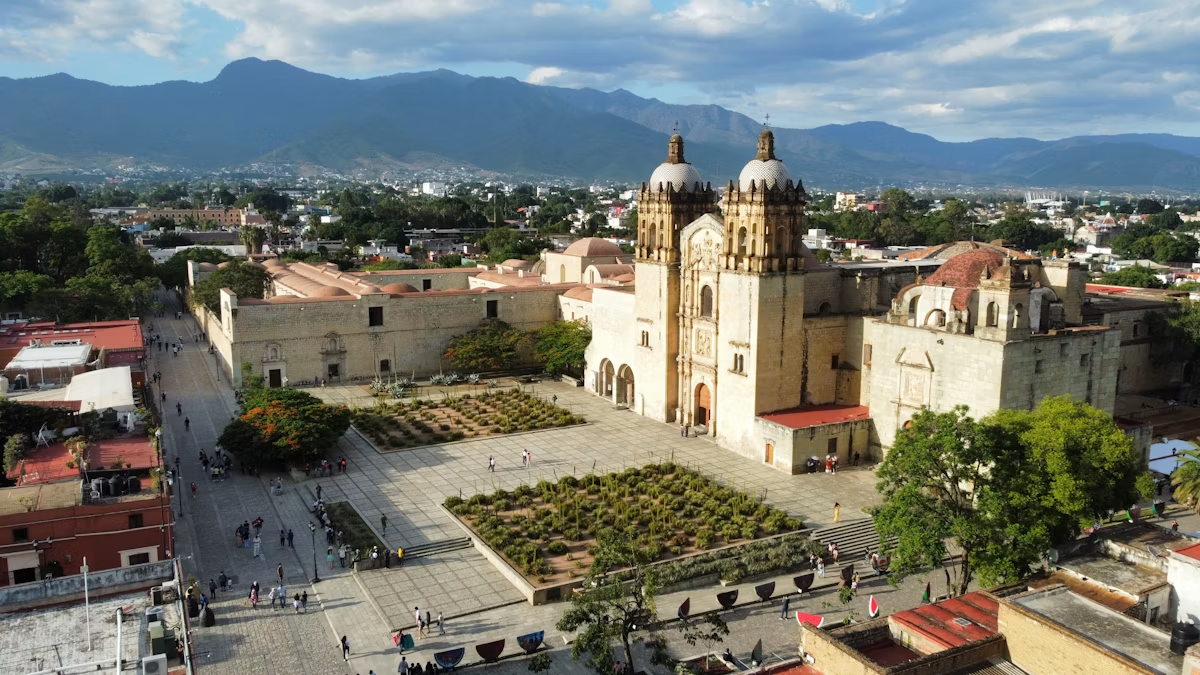
Photo by ryan doyle on Unsplash
Monte Albán: The Zapotec Capital
Monte Albán is the essential archaeological site in any Oaxaca travel guide — a hilltop city that was the capital of the Zapotec civilization from approximately 500 BCE to 700 CE, at its peak supporting 25,000 people on an artificially flattened mountaintop overlooking the Oaxaca Valley. The main plaza, surrounded by platforms, temples, and a ball court, was constructed by moving an estimated 3 million cubic meters of earth and stone without metal tools or wheeled vehicles.
What to see:
- Main Plaza: The central ceremonial space — 300 meters long, flanked by monumental platforms with broad staircases. Walking the plaza at the hour before closing (6 PM) with the valley below in golden light is one of the finest archaeological experiences in Mexico
- Building J (the Observatory): An arrow-shaped building oriented toward specific star positions, with tunnels and niches that track celestial events — the most distinctive building in the complex
- The Danzantes: 300+ carved stone slabs depicting naked, contorted figures (possibly captives or sacrificial victims) — some of the earliest evidence of writing in Mesoamerica
Logistics: Taxi from Oaxaca city: MXN 200–300 ($11.11–$16.67) round trip (including 2-hour wait). Collectivo bus from Calle Tinoco y Palacios: MXN 25 ($1.39) each way. Entry: MXN 100 ($5.56). Allow 3 hours minimum.
Oaxacan Food: The Core of Every Oaxaca Travel Guide
Oaxacan cuisine is considered one of the most complex regional cuisines in Mexico — and Mexico’s regional cuisines are among the most complex in the world. The Oaxacan food identity is built around seven moles, a specific variety of corn, locally raised meats, and the insects and plants of the Oaxacan mountains and valleys.
Essential Oaxacan food for every Oaxaca travel guide visitor:
The Moles
Oaxaca is “the land of seven moles” — seven distinct sauce-based preparations that are the foundation of Oaxacan cooking. Mole negro (the most complex, with 30+ ingredients including chocolate and dried chilies) and mole coloradito (brick-red, slightly sweet) are the two most commonly encountered. Mole negro enchiladas: MXN 80–150 ($4.44–$8.33) at local restaurants.
Tlayuda
The Oaxacan tostada — a large, partially crispy corn tortilla topped with asiento (unrefined pork fat), black beans, Oaxacan quesillo cheese, and a choice of tasajo (dried beef), cecina (pork), or chorizo. The definitive Oaxacan street meal. MXN 80–120 ($4.44–$6.67) from market vendors and small restaurants.
Quesillo (Oaxacan String Cheese)
The fresh string cheese pulled into characteristic ribbon rolls — sold fresh from dairy stalls in the Juárez Market at MXN 80–120/kg ($4.44–$6.67). It belongs to everything: tlayudas, enfrijoladas, memelas, or simply pulled apart and eaten with tortillas.
Chapulines
Toasted, lime-seasoned grasshoppers — a Zapotec protein source consumed in Oaxaca for millennia and now the most discussed Oaxaca travel guide food item. MXN 30–60 ($1.67–$3.33) for a bag from market vendors; MXN 40–80 ($2.22–$4.44) as a taco topping at restaurants. Crunchy, salty, citrusy — genuinely excellent when fresh.
Chocolate de Oaxaca
Oaxacan drinking chocolate — ground cacao, cinnamon, and sugar, mixed with hot water or milk and frothed with a molinillo (a wooden whisk). The Mayan-descended preparation that bears little resemblance to European hot chocolate. MXN 30–50 ($1.67–$2.78) at the Cacao Museo or the chocolate-grinding mills on Mina street.
Best restaurants in any Oaxaca travel guide:
- Los Pacos: Classic Oaxacan food at local prices — tlayudas, moles, and memelas in a simple dining room. MXN 80–150 ($4.44–$8.33)
- Mercado 20 de Noviembre smoke alley: The most authentic and affordable option — coals, smoke, and fresh grilled meats. MXN 60–100 ($3.33–$5.56) per plate
- Casa Oaxaca (upscale): The leading fine-dining interpretation of Oaxacan cuisine — reservation required. MXN 400–700 ($22.22–$38.89) per person
Mezcal: The Essential Oaxaca Travel Guide Experience
Oaxaca produces approximately 85% of Mexico’s mezcal — a spirit distilled from the agave plant in a process that has been practiced in the Oaxacan mountains for 400+ years. Unlike the industrial production of most tequila, most Oaxacan mezcal is still produced artisanally: roasting agave hearts in earthen pits over firewood (which creates the signature smokiness), crushing them with stone wheel (tahona) or wooden mallets, fermenting in open wooden vats with wild yeast, and distilling in clay or copper pot stills.
Oaxaca mezcal education:
- El Palenque (Matatlan town, 50 km from Oaxaca): The “World Mezcal Capital” — a village where nearly every building is a mezcal distillery. Free to visit most palenques; free tasting at most small producers
- La Mezcaloteca (Reforma 506, Oaxaca): A curated mezcal bar-library with guided tastings — the best introduction to Oaxacan mezcal varieties for the uninitiated. Tasting MXN 200–400 ($11.11–$22.22)
- Boulenc (mezcal bar/bakery): For the Oaxaca travel guide visitor who wants excellent mezcal alongside equally excellent wood-fired bread
Buying mezcal to take home: The Juárez Market has vendors selling small artisanal producers’ mezcal at origin prices (MXN 150–400 / $8.33–$22.22 per 750ml bottle) for mezcals that retail internationally at 5–10x that price. Declare it properly on return customs.
Oaxacan Textiles and Markets
Oaxaca has one of the most vibrant indigenous textile traditions in Mexico — the villages of the Oaxaca Central Valleys each specialize in distinct weaving styles, patterns, and dyeing techniques that have been practiced for centuries.
Key textile markets and villages:
- Tlacolula Market (Sunday, 30 km): The largest weekly market in the Oaxacan valleys — indigenous vendors from across the region selling textiles, produce, dried chilies, and mezcal. The most important market day trip in any Oaxaca travel guide. Collectivo from Oaxaca: MXN 20 ($1.11)
- Teotitlán del Valle (30 km): The rug-weaving village — hand-loomed wool rugs using natural dyes (indigo, cochineal from the carmine insect, marigold) in pre-Columbian Zapotec designs. Workshop visits free; rugs MXN 500–5,000+ ($27.78–$277.78) depending on size and complexity
- San Bartolo Coyotepec (12 km): The black pottery (barro negro) village — distinctive hand-polished black ceramics fired in traditional kilns. Pottery MXN 80–500 ($4.44–$27.78)
Día de los Muertos in Oaxaca
Every Oaxaca travel guide addresses Día de los Muertos with urgency: the November 1–2 celebration in Oaxaca is among the most significant cultural events in Mexico, and the Oaxacan version — rooted in Zapotec ancestor veneration practices that predate the Spanish colonial overlay — is considerably more indigenous and less commercialized than the Mexico City version.
What happens: Families build elaborate altars (ofrendas) in their homes and carry food, flowers (marigold/cempasúchil), photographs, and candles to graves in the town cemeteries. The cemeteries on the nights of November 1–2 are extraordinary — candlelit, flower-strewn, filled with both grief and celebration. Visitors are welcome if respectful and non-intrusive. The Etla cemetery and the San Felipe del Agua cemetery are less crowded than the central Xoxocotlán (a 30-minute walk from the city).
Practical note: Book accommodation in Oaxaca for Día de los Muertos at minimum 3–4 months in advance. Prices double or triple; the city is at maximum capacity.
Day Trips from Oaxaca
Hierve el Agua (70 km, 1.5 hrs)
A geological formation where mineral-rich springs have created petrified waterfall formations and natural infinity pools overlooking the Oaxacan valley. Entry: MXN 30 ($1.67). Organized tour: MXN 150–250 ($8.33–$13.89); collectivo plus local transport: MXN 80 ($4.44). The best half-day day trip in any Oaxaca travel guide.
Mitla (45 km, 1 hr)
The most important Zapotec site after Monte Albán — a post-Classic administrative center famous for its extraordinary geometric stone mosaic walls (the Greek fret pattern repeated in hundreds of variations). Entry: MXN 90 ($5.00). Collectivo from Oaxaca: MXN 20 ($1.11).
El Tule (10 km, 20 mins)
The widest tree in the world — a 2,000-year-old Montezuma cypress in the churchyard of Santa María del Tule with a trunk circumference of 58 meters. Takes 30 minutes out of any Monte Albán or Mitla day. Entry: MXN 20 ($1.11).
Where to Stay in Oaxaca
Budget (MXN 250–700 / $13.89–$38.89/night)
Oaxaca has an excellent budget accommodation market — guesthouses and small hotels in historic buildings, most within walking distance of the Zócalo. Azul Cielo Hostel and Casa Arnel are well-reviewed budget options near the center.
Mid-Range (MXN 900–2,500 / $50–$138.89/night)
Colonial-courtyard boutique hotels with breakfast included — some of the best mid-range accommodation in Mexico at this price point. Casa de las Bugambilias and Posada del Centro offer colonial character and good locations at reasonable prices.
Getting Around Oaxaca
Walking: The historic center is walkable in 15–20 minutes across; every major Oaxaca travel guide sight within the city is reachable on foot.
Collectivo (shared minivan): The primary transport to villages, day trip destinations, and the airport — MXN 15–30 ($0.83–$1.67) per seat. Depart from specific points around the central market area.
Taxi: Metered within the city — MXN 60–120 ($3.33–$6.67) for most city journeys.
Daily Budget Breakdown
| Category | Budget | Comfortable |
|---|---|---|
| Accommodation | $18 (guesthouse) | $70 (boutique hotel) |
| Food (3 meals) | $12 | $35 |
| Transport | $3 | $10 |
| Activities / markets | $8 | $25 |
| Daily Total | ~$41 | ~$140 |
Final Verdict: Oaxaca Travel Guide 2026
Oaxaca rewards duration. The first day is spent orienting in the historic center and eating your first tlayuda. The second involves Monte Albán and an evening mezcal education at La Mezcaloteca. The third opens up the villages — a Sunday Tlacolula market, Teotitlán del Valle, Hierve el Agua. And beyond a week, the city reveals the depth that makes it one of Mexico’s great destinations: cooking classes that go into the mole philosophy, palenque visits in the mezcal villages, the rhythm of market days that structure the Oaxacan week. Every Oaxaca travel guide recommends 5–7 days minimum, and the honest answer for anyone who engages with the food and craft culture seriously is to stay longer.