
Croatia travel guide readers arrive expecting Game of Thrones filming locations and find an entire country that looks like a set — 1,778 kilometers of Adriatic coastline studded with 1,244 islands, a medieval walled city that has been continuously inhabited since the 7th century, turquoise lakes connected by travertine waterfalls inside a national park that exists 90 minutes from the coast, and a wine culture rooted in grape varieties found nowhere else on earth. Croatia has transformed in two decades from a post-war recovery destination into one of Europe’s most visited summer destinations, with 20 million tourists per year now significantly outnumbering its 3.9 million residents. This Croatia travel guide covers Split, Dubrovnik, Hvar, Korčula, Zadar, Plitvice Lakes, the Dalmatian coast ferry network, and a complete 2026 budget breakdown for peak and shoulder season.
At a Glance
| Country | Republic of Croatia |
| Currency | Euro (€) — Croatia joined the Eurozone in January 2023 |
| Language | Croatian; English widely spoken in tourist areas |
| Best time | May–June or September–October (warm, fewer crowds, lower prices than July–August) |
| Avoid | July–August peak (extreme crowds; prices 40–60% higher; ferries book out weeks ahead) |
| Daily budget | €60–€90/day hostel + local food |
| Mid-range | €150–€280/day |
| Visa | Visa-free for US, EU, UK, Canadian, Australian citizens (90 days within Schengen) |
| Getting there | Split Airport (SPU) or Dubrovnik Airport (DBV); Zagreb (ZAG) for inland entry |
| Getting around | Jadrolinija ferries between islands; rental car for mainland; buses between cities |
Split: Diocletian’s Palace and the Dalmatian Coast
This Croatia travel guide begins in Split — the second-largest city in Croatia and the transit hub of the Dalmatian coast, built inside and around the retirement palace of Roman Emperor Diocletian (305 CE) in a way that has produced one of the most unusual city centres in Europe.
Diocletian’s Palace: The must-visit site in any Croatia travel guide — a UNESCO World Heritage Site since 1979 — not a museum but a living neighbourhood of 3,000 residents, restaurants, bars, and shops occupying the cellars, courtyards, and towers of a 4th-century Roman imperial palace. The Peristyle (the ceremonial courtyard) and Cathedral of Saint Domnius (a Roman mausoleum converted to a Christian cathedral in the 7th century; €5 entry including the bell tower climb) are the centrepieces. Entry to the palace complex itself is free and open at all hours — the old town streets inside the walls are the finest free attraction on the Adriatic coast.
Meštrović Gallery: The home and studio of Croatia’s greatest sculptor, Ivan Meštrović (1883–1962) — a 1930s villa above the sea housing 200 bronzes, marbles, and woodcarvings covering 30 years of production. Entry €10; one of the most undervisited art museums in the Mediterranean.
Klis Fortress: A Croatia travel guide bonus stop — a 6th-century hilltop fortification 8 kilometers above Split (bus or taxi; €6–€10 each way) — filming location for the Meereen slave city scenes in Game of Thrones, and in its own right a remarkable military complex with panoramic views of the Dalmatian hinterland. Entry €8.
Dubrovnik: The Walled City
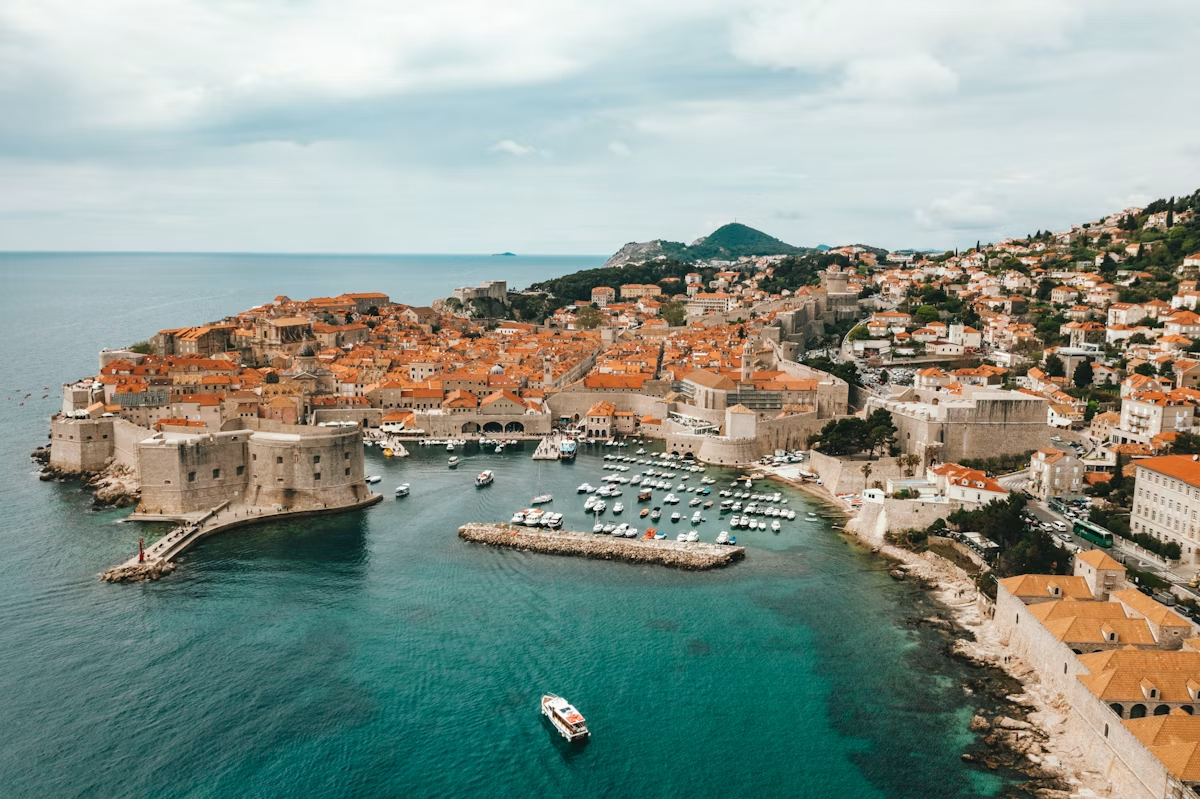
No Croatia travel guide is complete without a frank account of Dubrovnik — a UNESCO-listed medieval city of almost impossible beauty that is simultaneously one of the most overcrowded destinations in Europe in peak season.
The City Walls (2 kilometres of 10–25-meter fortifications encircling the entire Old Town; entry €35; best walked at 8am before cruise ships disembark) provide the defining Dubrovnik experience — the orange-roofed limestone cityscape from the southwest tower overlooking the Adriatic is the most photographed view in Croatia. The Rector’s Palace (former seat of the Dubrovnik Republic government; €15), the Dominican Monastery (15th-century cloister with a Titian painting; €8), and Fort Lovrijenac (the “Gibraltar of Dubrovnik”; used as King’s Landing in the series; €35 included in wall ticket) are the main interior attractions.
Managing the crowds: The daily visitor limit of 8,000 (introduced in 2017 to protect the walls) is regularly exceeded in July and August. This Croatia travel guide’s practical advice: arrive in May or October when the old town returns to a human scale. If visiting in summer, the cable car to Mount Srđ (€23 return) is the best early-morning escape — the city at 412 metres before 8am, with empty air and clear views of the islands.
Lokrum Island: A 10-minute ferry from the Old Town harbour (€19 return; runs every 30 minutes in season) — a nature reserve of subtropical botanic gardens, peacocks, a saltwater lake, and a ruined Benedictine monastery. No hotels or permanent residents; closes at sunset.
The Islands: Hvar, Korčula, and Brač
This Croatia travel guide recommends at least one island stay — the 1,244 Croatian islands include some of the finest Mediterranean island landscapes in Europe, accessible by regular ferry from Split and Dubrovnik.
Hvar
The most popular island in this Croatia travel guide — a long thin island of lavender fields, medieval hilltop fortresses, boutique hotels, and the most reliably sunny weather in the country (2,726 hours of sun per year; the driest place in Croatia). Hvar Town’s main square (the largest in Dalmatia), the Spanish Fortress above town (free entry), and the Stari Grad Plain (a UNESCO-listed 4th-century BCE Greek agricultural landscape still farmed in the same field divisions) are the cultural anchors. The Pakleni Islands (a scattered archipelago of pine-forested islets just offshore; water-taxi from Hvar Town harbour) offer the best swimming and snorkelling water on the island. Ferry from Split to Stari Grad: 2 hours; €7–€9.
Korčula
A medieval walled town on a small island that claims to be the birthplace of Marco Polo (contested with Venice, but Korčula makes the more compelling architectural case) — smaller, quieter, and more authentically Dalmatian than Hvar. The sword dance (Moreška) performed in July and August is one of the last surviving medieval folk tournaments in the Mediterranean. Ferry from Split: 3 hours; car ferry from Orebić (Pelješac Peninsula): 15 minutes.
Brač and the Golden Horn (Zlatni Rat)
The most photographed beach in Croatia — a white pebble peninsula that changes shape with the current and wind, pointing into the turquoise Adriatic at Bol on the south coast of Brač. The island is also the source of the white limestone used to build Diocletian’s Palace, the White House in Washington DC, and the United Nations building in New York. Ferry from Split to Supetar: 50 minutes; €7.
Plitvice Lakes National Park
Every Croatia travel guide prioritises Plitvice Lakes — a UNESCO World Heritage Site of 16 terraced travertine lakes connected by 90 waterfalls in a karst canyon, producing a landscape of such unlikely colour (from turquoise to emerald green, shifting by season, depth, and sunlight angle) that it consistently appears on lists of the world’s most beautiful places.
Entry is €23.50–€46.50 depending on season (highest July–August); the park operates two ticket options: Entrance 1 (lower lakes; the most photogenic section; shorter circuit) and Entrance 2 (upper lakes; longer; less crowded). A full day covers both circuits (10–12 kilometres of boardwalk; allow 4–5 hours). Accommodation in the park is at three hotels (managed by the national park authority; book 6 months ahead for summer). Day trip by bus from Split: 3–3.5 hours (€25–€35 return by shuttle); from Zagreb: 2 hours.
Zadar and the Dalmatian North
This Croatia travel guide recommends Zadar as the most underrated city on the Dalmatian coast — a Roman-era grid of churches and marble streets that Alfred Hitchcock called home to the most beautiful sunset in the world, and that most visitors bypass on the way to Split.
Sea Organ: A 70-metre shoreline installation (architect Nikola Bašić, 2005) — 35 organ pipes built into the steps descending to the sea, producing musical chords as waves push air through the chambers. Free; plays continuously; most resonant in strong westerly wind with a large swell.
Sun Salutation: A circular solar energy installation adjacent to the Sea Organ — 300 glass plates collecting solar energy during the day and producing a light show after dark. Free.
St Donatus Church: A 9th-century pre-Romanesque rotunda built over a Roman forum — one of the most architecturally distinctive early medieval churches in Croatia. Entry €5; the acoustics inside make it a venue for the Musical Evenings in St Donatus festival each summer.
Day Trips and Excursions
Pelješac Peninsula and Wine
The peninsula north of Dubrovnik produces Dingač and Postup — two of Croatia’s finest red wines made from the Plavac Mali grape (a genetic ancestor of Zinfandel/Primitivo). Winery visits with tasting at Miloš, Bura-Mrgudić, and Grgić Vina (the Croatian-American winemaker Mike Grgich of Chateau Montelena fame) run €15–€30 per person. The Ston oyster beds on the inner bay produce the sweetest oysters in the Adriatic; bought directly from oystermen for €10–€12 per dozen.
Krka National Park (45 min from Šibenik)
A second national park of travertine waterfalls — less famous than Plitvice, with the advantage of allowing swimming directly below the Skradinski Buk waterfall (Plitvice does not permit swimming). Entry €26.50; accessible by bus from Split in 2 hours.
Vis Island
The farthest inhabited island from the Croatian mainland — 2.5 hours by catamaran from Split — and formerly a Yugoslav military base closed to foreigners until 1989. The Blue Cave (Modra Špilja) on nearby Biševo island (accessible by speedboat tour from Vis Town; €35) fills with iridescent blue light from an underwater entrance between 11am and noon on sunny days.
Food and Drink
- Peka: Every Croatia travel guide highlights the definitive Dalmatian cooking method — lamb, veal, or octopus slow-cooked under a cast-iron dome (peka) covered in embers for 2–3 hours. Must be pre-ordered 24 hours ahead at traditional konobas (rustic restaurants); the most rewarding meal in the Croatia travel guide food section.
- Buzara: Shellfish (mussels, clams, or scampi) cooked in olive oil, white wine, garlic, and breadcrumbs — the coastal preparation that captures the Adriatic in a pan. €12–€20 per portion at waterfront konobas.
- Štrukli: A baked or boiled dough pastry filled with fresh cottage cheese — the national dish of the Zagreb and Zagorje region (distinct from coastal food). Available at Zagreb’s Stari Fijaker and Trilogija restaurants; €8–€12.
- Rakija: The ubiquitous fruit brandy — grappa-like in strength (40–60% ABV), served as a digestif or welcome drink at every konoba. Travarica (herb-infused), maraschino (Marasca cherry), and medica (honey) are the most characterful variants.
- Pag cheese (Paški sir): A hard sheep’s milk cheese from the island of Pag, where the sheep graze on sage and salt-wind-dried grass — a PDO-protected product with an intensity comparable to aged Manchego. Sold at markets throughout Croatia; €20–€30 per kilogram.
Where to Stay
Budget (€25–€60/night)
Hostels in Split (Hostel Stari Grad), Dubrovnik (Hostel Angelina), and Zadar (Hostel Forum) offer dorms from €20 and private rooms from €45. Private sobe (rooms in local family homes — the Croatian equivalent of B&B) offer the best value in coastal towns; look for handwritten signs or book via Booking.com for €35–€60.
Mid-Range (€100–€220/night)
The standard Croatia travel guide accommodation tier: boutique hotels inside Diocletian’s Palace in Split, or stone-villa hotels in Hvar and Korčula. Villa Dvor (Omiš), Heritage Hotel Life Palace (Split), and Korsal (Korčula) represent the range.
Luxury (€350–€1,200+/night)
For travelers using this Croatia travel guide to experience the Adriatic at its most refined: Villa Dubrovnik (cliff-side hotel above the old town; from €600), Boutique Hotel Stari Grad (Split; 12 rooms inside the Palace walls; from €350), and Hvar’s Adriana Hotel (from €400).
Getting Around
The ferry network is the defining infrastructure of any Croatia travel guide, and understanding it before arrival saves significant time and money.
Jadrolinija ferries: The backbone of any Croatia travel guide logistics section — the state-owned operator running car and passenger ferries between Split and the main islands (Hvar, Brač, Vis, Korčula, Lastovo) and along the coast to Dubrovnik. Book car ferries in advance for summer travel — foot passenger spaces are almost always available without reservation. The coastal ferry Split–Dubrovnik (8 hours; €25 foot passenger) stops at Hvar, Korčula, and Mljet and is one of the most scenic ferry journeys in the Mediterranean.
Krilo and Kapetan Luka: Private catamaran operators running faster services between Split, Hvar, Korčula, and Dubrovnik (3–4 hours Split–Dubrovnik; €35–€55). Book online 48+ hours ahead in July–August.
Rental car: A Croatia travel guide essential for inland travel — needed for Plitvice Lakes, the Pelješac Peninsula, and the Dalmatian hinterland. The Adriatic Highway (D8) between Zadar and Split is one of Europe’s most scenic coastal drives. From €30/day at Split Airport.
Buses: FlixBus and Croatia Bus connect Zagreb, Split, Dubrovnik, Zadar, and Šibenik. Zagreb–Split: 5 hours; €15–€25. Split–Dubrovnik: 4.5 hours; €15–€20.
Daily Budget Breakdown
The figures in this Croatia travel guide reflect 2026 shoulder season (May/September) and peak season (July/August) pricing.
| Category | Budget | Mid-Range | Luxury |
|---|---|---|---|
| Accommodation | €45 | €160 | €600 |
| Meals | €20 | €55 | €150 |
| Transport | €15 | €30 | €50 |
| Attractions | €10 | €40 | €80 |
| Daily Total | €90 (~$98) | €285 (~$310) | €880 (~$957) |
Peak season (July–August) adds 40–60% to accommodation costs across all tiers.
Final Verdict: Croatia Travel Guide 2026
The ideal Croatia travel guide itinerary runs 10–14 days for the Dalmatian coast — Split (2–3 nights as base), Hvar (2 nights), Korčula (1–2 nights), Dubrovnik (2–3 nights) — with Plitvice Lakes as either a day trip from Split or an overnight stop en route from Zagreb. This Croatia travel guide’s strongest recommendation: visit in May or September rather than July or August. The water temperature is identical (24–26°C), the prices are 30–50% lower, the ferry queues are manageable, and the walled streets of Dubrovnik and Split belong to residents rather than to 10,000 cruise passengers. Book Dubrovnik accommodation and summer ferry crossings 2–3 months in advance; everything else in Croatia can be arranged with 1–2 weeks’ notice outside of peak season.