
Ireland travel guide readers encounter one of Europe’s most contradictory destinations — an island of 5 million people that has produced four Nobel laureates in literature (Shaw, Yeats, Beckett, Heaney) while simultaneously building a tourist economy around the image of leprechauns and a colour of green that the country’s perpetual rain genuinely earns, where a farmer in Connemara will stop his tractor to give directions with the same unhurried precision as a Trinity College professor explaining Ulysses, and where a medieval castle hosting a candlelit medieval banquet is positioned 400 metres from one of the most dramatic ocean cliff edges in Europe. The island of Ireland covers 84,000 square kilometres, the Republic of Ireland comprising the southern five-sixths and Northern Ireland (part of the United Kingdom) the northern quarter. This Ireland travel guide covers Dublin, the Wild Atlantic Way, the Ring of Kerry, the Cliffs of Moher, Galway, the Aran Islands, the Causeway Coastal Route in Northern Ireland, whiskey distillery touring, and a complete 2026 budget breakdown.
At a Glance
| Country | Republic of Ireland (south); Northern Ireland / UK (north) |
| Currency | Euro (€) in the Republic; British Pound (£) in Northern Ireland |
| Language | English; Irish (Gaeilge) — official first language, spoken daily in Gaeltacht regions |
| Best time | May–September (mildest weather; longest days; festivals) |
| Avoid | November–February (short days; frequent rain; some coastal attractions windswept to unusability) |
| Daily budget | €70–€100/day hostel + pub food |
| Mid-range | €180–€320/day |
| Visa | Visa-free for US, EU, Australian, Canadian citizens; UK passport holders move freely between Republic and Northern Ireland |
| Getting there | Dublin Airport (DUB) — main hub; Shannon (SNN) for west coast; Cork (ORK) for the south |
| Getting around | Rental car strongly recommended outside Dublin; Irish Rail for Dublin–Cork–Galway corridor; Bus Éireann for rural areas |
Dublin: Literature, Pubs, and Georgian Squares
This Ireland travel guide begins in Dublin — a compact, walkable capital of 1.4 million people built on both banks of the Liffey, where the architecture ranges from 18th-century Georgian townhouses to the steel and glass of the Silicon Docks (European headquarters of Google, Facebook, and LinkedIn), and where the density of pubs per resident remains among the highest of any capital city in Europe.
Trinity College and the Book of Kells: The first stop in any Ireland travel guide — The oldest university in Ireland (1592) — a 47-acre campus in the city centre, free to walk during term time. The Long Room library (1,000-year-old manuscripts, 200,000 books, and the harp that gave Ireland its national symbol) houses the Book of Kells, an illuminated gospel manuscript produced by Celtic monks around 800 CE and considered the finest example of medieval manuscript art in existence. Entry €14–€18 (timed entry; book online). The Science Gallery on Nassau Street (free) rounds out the Trinity campus visit.
National Museum of Ireland (Archaeology): Free entry; the Ardagh Chalice (8th century), the Tara Brooch, and the Clonmacnoise Crozier are among the finest examples of Early Christian metalwork anywhere in the world. The bog bodies — Iron Age humans preserved for 2,500 years in Irish peat bogs — are both unsettling and extraordinary. Open Tuesday–Saturday 10am–5pm.
Kilmainham Gaol: An Ireland travel guide essential — the most important historical site in Dublin — a decommissioned Victorian prison that held the leaders of the 1916 Easter Rising before their execution in the prison yard (the executions converted public opinion from ambivalence to nationalist fervour and directly led to Irish independence). Guided tour only; €8; book weeks in advance in summer.
The Liberties and Guinness Storehouse: The oldest working-class neighbourhood in Dublin — the Iveagh Trust tenement buildings, the covered Thomas Street market, and the Guinness Storehouse (a seven-floor interactive museum inside the St James’s Gate Brewery; entry €26–€32; the rooftop Gravity Bar pint included; the most visited tourist attraction in Ireland). The Teeling, Roe & Co, and Pearse Lyons distilleries are all within walking distance for a full Dublin whiskey and brewing trail.
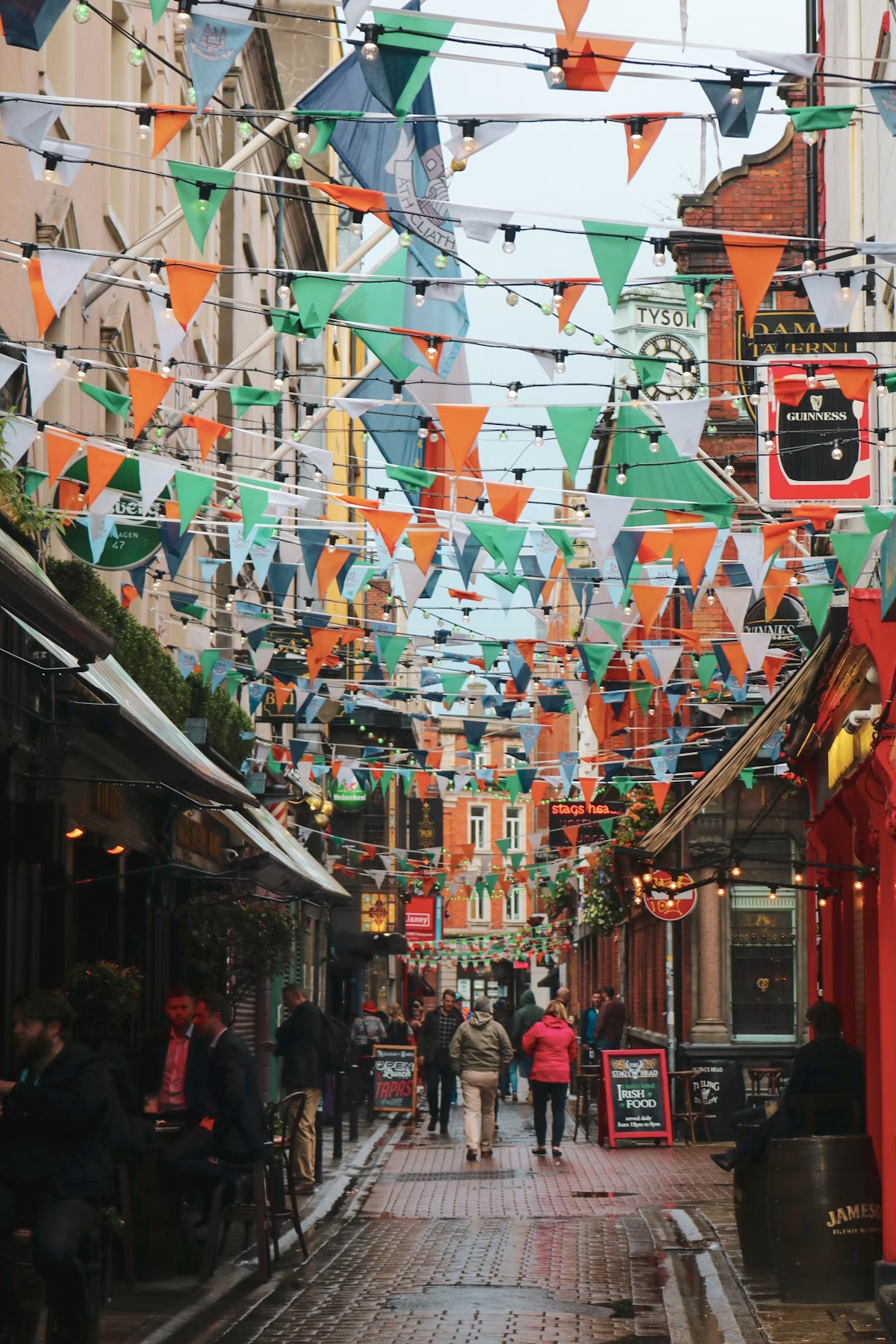
Temple Bar and beyond: Temple Bar (the cobblestoned cultural quarter) is simultaneously the most atmospheric and most tourist-priced neighbourhood in Dublin — essential for one evening, overpriced for staying or eating. The surrounding areas of Portobello, Rathmines, and Stoneybatter offer the same Georgian architecture at normal restaurant prices with better food.
The Wild Atlantic Way
No Ireland travel guide is complete without the Wild Atlantic Way — a 2,500-kilometre signposted coastal route from Malin Head (the northernmost point of Ireland) to Mizen Head (the southernmost tip of County Cork), passing through some of the most dramatic ocean scenery in Europe.
Cliffs of Moher (County Clare): The headline attraction of any Ireland travel guide — 214-metre vertical sea cliffs extending for 8 kilometres above the Atlantic — the most visited natural attraction in Ireland (1.5 million visitors per year). The Visitor Experience centre (€9 parking fee includes access) sits above the central section; the Moher Coastal Walk connects the cliffs to Doolin village (5 kilometres; 2 hours) for those who want the view without the coach tour crowds. Arrive before 9am or after 5pm for the best experience. Weather changes fast — the same cliffs that appear in clear afternoon light can be completely fogged within 20 minutes.
The Burren (County Clare): A unique Ireland travel guide detour — a 560-square-kilometre limestone plateau immediately north of the Cliffs of Moher — a unique karst landscape where Arctic, Alpine, and Mediterranean plant species coexist in the same limestone pavement cracks, due to the Gulf Stream’s tempering effect on an otherwise northerly latitude. Poulnabrone Portal Tomb (a Neolithic dolmen dating to 4,200 BCE; free; roadside access) is the most visited site within the Burren.
Connemara (County Galway): The wildest landscape in this Ireland travel guide — the wild interior behind Galway — blanket bog, quartzite mountains (the Twelve Bens range), interconnected lakes, and the densest surviving Irish-speaking (Gaeltacht) community in the country. Kylemore Abbey (a Victorian Gothic fantasy castle reflected in a lake; €15 entry including walled garden) and Sky Road (a 12-kilometre coastal loop above Clifden with Atlantic views) are the main fixed stops; the landscape itself is the primary attraction.
Achill Island (County Mayo): The largest island in Ireland — connected to the mainland by a bridge, with five Blue Flag beaches, the sea cliffs of Croaghaun (688 metres; among the highest sea cliffs in Europe), and an abandoned pre-Famine village (the Deserted Village of Slievemore) that was inhabited until the Great Famine of 1847 and left essentially intact.
The Ring of Kerry
This Ireland travel guide recommends the Ring of Kerry for first-time visitors to the southwest — a 179-kilometre circular route around the Iveragh Peninsula in County Kerry, passing through mountain passes, lakeside towns, and some of the most consistently impressive coastal scenery in Ireland.
Key stops (clockwise from Killarney):
- Killarney National Park: The oldest national park in Ireland (1932) — three lakes, the MacGillycuddy’s Reeks mountain range (including Carrauntoohil, Ireland’s highest peak at 1,038 metres), and the Victorian Ross Castle (€5 entry) accessible by jaunting car (horse-drawn carriage; €20–€30 per group).
- Skellig Michael: Every Ireland travel guide covers this UNESCO World Heritage Site 12 kilometres off the Kerry coast — a monastic settlement established by early Christian monks in the 6th century CE on a 230-metre sea stack, now accessible by licensed boat from Portmagee (€85–€120 return; strict weather dependency; 600 stone steps to the beehive cells). The site served as Luke Skywalker’s island in Star Wars: The Force Awakens (2015).
- Sneem and Kenmare: Two of the finest village squares in Kerry — colourful shop fronts, independent restaurants, and the best access points to the Beara Peninsula’s quieter scenery.
- Ladies View: A Victorian-era viewpoint above the Upper Lake of Killarney, named after Queen Victoria’s ladies-in-waiting who stopped here in 1861 and declared it the finest view in Ireland. Still accurate.
Galway and the Aran Islands
Every Ireland travel guide highlights Galway — the most musically alive city in Ireland, where traditional Irish music (trad) sessions in pubs are genuinely spontaneous rather than choreographed for tourists, and where the Saturday market beside the Spanish Arch has been operating since the 16th century.
Galway city: The cultural heart of this Ireland travel guide — Shop Street (the pedestrianised spine; buskers seven days a week) and its extensions into Quay Street and Cross Street contain the best concentration of trad pubs in the city — Tigh Coili, Tig Cóilí, The Crane, and Monroe’s Tavern are the most consistent; sessions typically begin 9–10pm and run until midnight or beyond. Galway Cathedral (1965; the newest Romanesque cathedral in Europe; free) and the Galway City Museum (free) are the cultural anchors.
Aran Islands: Three limestone islands at the mouth of Galway Bay — Inis Mór (the largest; the cliff fort of Dún Aonghasa, 100 metres above the Atlantic; €5 entry), Inis Meáin (the quietest; the playwright J.M. Synge spent summers here in the 1890s and based The Playboy of the Western World on stories he collected), and Inis Oírr (the smallest; a 14th-century castle half-buried in sand). Ferry from Rossaveal (30 min; €25 return; shuttle from Galway city included) or Doolin (Inis Oírr only; 30 min; €25). Bicycle rental on Inis Mór covers the island in 3–4 hours (€15/day).
Northern Ireland: Giant’s Causeway and Belfast
This Ireland travel guide covers Northern Ireland as an integral part of any island itinerary — there is no border infrastructure between the Republic and Northern Ireland since the 1998 Good Friday Agreement, and the crossing is marked only by a change in road sign colour and currency.
Giant’s Causeway (County Antrim): The Northern Ireland highlight of any Ireland travel guide — a UNESCO World Heritage Site of 40,000 interlocking basalt columns formed by ancient volcanic activity, arranged at the cliff base in a geometric pattern so precise that local legend attributed them to the giant Fionn mac Cumhaill building a road to Scotland. The National Trust visitor centre (£13.50; free if walking direct to the causeway without parking in the National Trust car park) manages access. The Causeway Coastal Route (A2) connecting Belfast to Ballycastle via the rope bridge at Carrick-a-Rede (£14.50; book online) is one of the finest coastal drives in the British Isles.
Belfast: The Ireland travel guide section most visitors underestimate — a city that has transformed from a conflict-associated destination into one of Britain and Ireland’s most interesting urban tourism destinations — the Titanic Quarter (the ship was built here; the Titanic Belfast museum, opened 2012, is the most visited attraction in Northern Ireland at £21 entry), the Cathedral Quarter murals (political wall paintings from the Troubles documenting the 1969–1998 conflict), the Black Cab political tours (2 hours; £35/person), and the rapidly expanding restaurant scene around the Merchant Hotel and St George’s Market (Friday–Sunday; free entry; the finest covered market in Ireland).
Whiskey and Pub Culture
- Irish whiskey distilleries: The whiskey (spelled with an ‘e’ in Ireland, without in Scotland) industry has expanded from 2 distilleries in 2012 to over 40 in 2026 — the fastest growing spirits category in the world. Jameson Distillery (Dublin; €28 guided tour with tasting), Teeling (Dublin Liberties; €22), Dingle Distillery (County Kerry; €20), and Slane Castle Distillery (County Meath; €22 with castle access) represent the range from urban to estate.
- Trad sessions: Every Ireland travel guide’s favourite evening recommendation — traditional Irish music performed in a pub — fiddle, uilleann pipes, tin whistle, bodhrán — is not a performance but a communal gathering where musicians join as they arrive. Doolin (County Clare), Kilronan (Inis Mór), and Milltown Malbay (home of the Willie Clancy Summer School in July) are the most authentic trad towns in the country.
- The pint of Guinness: The stout poured over a precise 119.5-second two-part process at the correct temperature (6°C) in a specific glass (the Guinness tulip pint) — approximately 1.5% of the world’s Guinness is consumed in Ireland daily, and the pint genuinely tastes better closer to the St James’s Gate source. Expect to pay €6–€7.50 in Dublin; €5–€6.50 in rural pubs.
Where to Stay
Budget (€25–€60/night)
Hostels in Dublin (Generator Dublin, Abigail’s Hostel, Abbey Court) and Galway (Barnacles Hostel, Snoozles). Rural B&Bs (bed and breakfast in family homes; the standard Irish budget accommodation outside cities) from €45–€70 per person including a full Irish breakfast.
Mid-Range (€100–€220/night)
The standard Ireland travel guide accommodation tier: country house hotels and boutique guesthouses throughout Kerry, Clare, and Galway. The full Irish country house experience — turf fires, antique furniture, four-course dinner included — is available from €140 at places like Ballynahinch Castle (Connemara) and Sheen Falls Lodge (Kenmare) in shoulder season.
Luxury (€300–€1,000+/night)
For travelers using this Ireland travel guide to experience the country at its most refined: Ashford Castle (County Mayo; a 13th-century castle on the shores of Lough Corrib; from €500 including breakfast), Adare Manor (County Limerick; Palladian country house with championship golf course; from €600), and The Merrion (Dublin; Georgian terrace hotel with Ireland’s finest art collection; from €400).
Getting Around Ireland
The car question is the central logistics decision of any Ireland travel guide, and the answer is clear outside Dublin: you need one.
Rental car: The most important logistics decision in any Ireland travel guide — essential for the Ring of Kerry, Wild Atlantic Way, Connemara, and the Causeway Coastal Route. Left-hand traffic (same as UK); many rural roads are single-lane with passing bays. Book from Dublin Airport; from €35–€55/day. Full insurance coverage recommended — stone walls and narrow lanes are ubiquitous outside cities. Fuel (petrol and diesel widely available; charging infrastructure expanding for EVs on major routes).
Irish Rail: The Ireland travel guide alternative to driving — connects Dublin Heuston to Cork (2.5 hrs; €19–€35), Dublin Connolly to Galway (2.25 hrs; €15–€30), and Dublin to Belfast (2 hrs; €19–€35 cross-border). The intercity rail network is comfortable and reliable; the rural network is limited.
Bus Éireann: National bus service connecting towns not on the rail network — useful for the Cliffs of Moher (bus from Galway or Ennis), but slow and infrequent in rural areas.
Dublin city transport: The Luas tram (two cross-city lines; tap-to-pay), Dublin Bus (extensive network), and DART coastal rail cover the city. The Leap Card (rechargeable; available at newsagents) gives 30% discount on all public transport in Dublin.
Daily Budget Breakdown
The figures in this Ireland travel guide reflect 2026 high season pricing in the Republic of Ireland.
| Category | Budget | Mid-Range | Luxury |
|---|---|---|---|
| Accommodation | €55 | €170 | €600 |
| Meals | €25 | €65 | €180 |
| Transport (car hire) | €40 | €50 | €70 |
| Attractions | €10 | €40 | €80 |
| Daily Total | €130 (~$142) | €325 (~$354) | €930 (~$1,013) |
Rural B&B with full Irish breakfast included reduces effective meal cost significantly.
Final Verdict: Ireland Travel Guide 2026
The ideal Ireland travel guide itinerary runs 10–14 days: Dublin (3 nights) → Galway and Connemara (2 nights) → Cliffs of Moher and the Burren (1 night in Doolin) → Ring of Kerry and Killarney (3 nights) → back north to Cork and onward or up to Belfast and the Giant’s Causeway (2–3 nights). This Ireland travel guide’s most consistent practical advice: book accommodation in Kerry and Clare for July and August at least 3 months ahead — the region has fewer hotel rooms than visitor demand, prices spike, and the best B&Bs sell out months in advance. May and September offer the best combination of viable weather (Ireland’s weather is never guaranteed, but both months are historically drier than summer), lower accommodation costs, and landscapes at their most vivid — the light in early May on the Connemara bogs and the Kerry mountains is exceptional.