
Porto is the answer to a question many Lisbon-based remote workers eventually ask: what if I could have the same quality of life, the same D8 visa access, the same Atlantic coast and Portuguese food culture — but with rents 25–35% lower, crowds 60% thinner, and a city that feels genuinely lived-in rather than optimized for tourism? The Porto digital nomad scene has grown steadily for five years and now offers everything Lisbon does, at a price point that makes long-term stays significantly more affordable. This guide covers everything you need to plan your move.
At a Glance
| Country | Portugal |
| Currency | Euro (€) — ~€0.92 per $1 USD |
| Language | Portuguese; English widely spoken |
| Best time to arrive | April–June, September–October |
| Monthly budget (comfortable) | €1,500–€2,400/month |
| Monthly budget (frugal) | €1,100–€1,500/month |
| Visa | Portugal D8 Digital Nomad Visa (same as Lisbon) |
| Airport | Francisco Sá Carneiro (OPO) — 20 min from city center |
| Co-working cost | €80–€150/month |
Porto vs Lisbon: Why Porto Digital Nomad Life Wins on Value
The Porto digital nomad community has a running joke: everyone who visits Porto to “check it out for a weekend” ends up staying three months. The city has a magnetic quality that Lisbon’s more polished, tourist-heavy atmosphere sometimes lacks — it feels rawer, more authentic, with the Douro River cutting through a city of granite churches, azulejo-tiled facades, and the world’s best port wine flowing at €2 a glass.
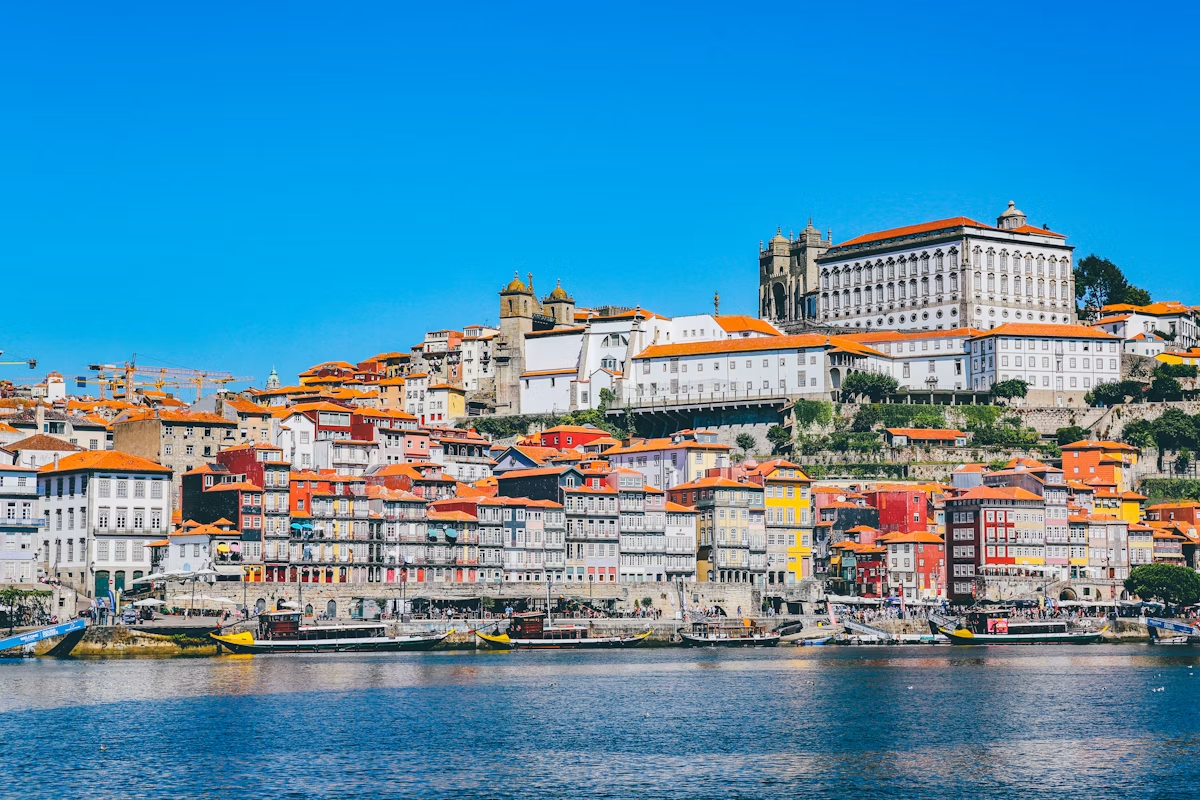
Photo by Nick Karvounis on Unsplash
The numbers make the case. Average rent for a furnished one-bedroom apartment in central Porto runs €950–€1,300/month, compared to €1,300–€1,800 in Lisbon. Co-working memberships run €80–€130/month. A coffee at a local café: €0.80–€1.20. A full francesinha (Porto’s signature heavy sandwich-stew) dinner: €12–€18. Over a six-month stay, the savings versus Lisbon compound significantly without any sacrifice in quality.
What’s Changed in 2026
- Porto’s co-working scene has expanded significantly — the Bonfim and Cedofeita districts have added 8–10 new spaces since 2023
- Short-term rental restrictions have tightened; furnished medium-term rentals (1–6 months) are now the standard route for nomad arrivals
- Direct flight connections from North American and Asian cities have increased, making Porto a viable entry point rather than an Lisbon-then-train itinerary
Best Neighborhoods for Porto Digital Nomads
Bonfim — Best Overall for Nomads
Bonfim has emerged as the Porto digital nomad neighborhood of choice. Situated east of the historic center, it combines affordable rents with the city’s best concentration of independent coffee shops, co-working spaces, and a creative community of locals and long-term residents. The neighborhood’s grid of 19th-century streets feels genuinely residential — local bakeries, neighborhood restaurants, and tascas coexist with the newer wave of specialty cafés.
- Rent (1BR furnished): €850–€1,200/month
- Best for: Long-term stays, daily café work culture, authentic neighborhood feel
- Transport: Metro (Marquês station, Yellow Line) connects to the city center in 10 minutes
Cedofeita — Best for Creative Workers
Cedofeita is Porto’s arts district — independent galleries, vintage shops, and a concentration of creative professionals make it feel like a small-city equivalent of Lisbon’s Príncipe Real. The café scene is strong, and several of Porto’s best co-working spaces are located here. Rents sit slightly below Bonfim.
- Rent (1BR furnished): €800–€1,100/month
- Best for: Creative professionals, those wanting gallery and arts scene access
- Transport: Well-connected by bus and tram; 15-minute walk to central Aliados
Ribeira — Best for Short Stays and Atmosphere
Porto’s riverside historic quarter (UNESCO World Heritage Site) is the city’s most photographed area — the stack of colorful houses descending to the Douro, the Dom Luís I bridge, and the rabelo boats on the river create one of Europe’s most recognizable urban views. Short-term furnished apartments command a premium but the setting is unmatched. Not the most practical base for daily work (cobblestones, hills, limited parking), but exceptional for stays of 1–2 months.
- Rent (1BR furnished): €1,100–€1,600/month (short-term premium)
- Best for: Short stays, atmosphere, couples
Foz do Douro — Best for Families and Longer Stays
West Porto, where the Douro meets the Atlantic, is the city’s most upscale residential neighborhood. Foz has a beach, wide boulevards, upscale restaurants, and larger apartments at prices that remain below Lisbon equivalents. Less walkable to co-working spaces but connected by tram to the center.
- Rent (1BR furnished): €1,000–€1,500/month
- Best for: Families, stays of 6+ months, those prioritizing space and seaside proximity
Best Co-Working Spaces in Porto
Cowork Central (Bonfim)
One of Porto’s best-regarded independent co-working spaces, Cowork Central operates from a renovated Bonfim building with high ceilings, natural light, and a community of local entrepreneurs and international remote workers. Monthly memberships include 24/7 access, meeting room credits, and regular networking events.
- Price: €90/month (hot desk), €130/month (dedicated)
- Wi-Fi: 300 Mbps fiber
- Best for: Full-time Porto digital nomad workers, professional networking
Sympla (Cedofeita)
Sympla is Porto’s most social co-working space — a converted ground-floor space in Cedofeita with an active events calendar, a strong creative community, and a café area that doubles as a workspace for members.
- Price: €80/month (hot desk)
- Best for: Creative workers, those wanting community alongside workspace
Ncrease (Multiple Locations)
A local Porto co-working chain with three locations across the city. Reliable fiber, professional atmosphere, and flexible membership terms make it the practical default for Porto digital nomad arrivals who want a consistent workspace without the social programming.
- Price: €75–€100/month
- Best for: Budget-conscious nomads, those needing a reliable desk without frills
Monthly Cost of Living in Porto (2026)
| Category | Budget | Mid-Range | Comfortable |
|---|---|---|---|
| Rent (1BR furnished) | €800 | €1,100 | €1,400 |
| Co-working | €0 (cafés) | €90 | €130 |
| Food & groceries | €200 | €320 | €500 |
| Transport (monthly pass) | €40 | €40 | €40 |
| Health insurance | €60 | €100 | €180 |
| Activities / misc | €80 | €170 | €300 |
| Total | ~€1,180 | ~€1,820 | ~€2,550 |
Porto’s food scene is one of the great underrated pleasures of Porto digital nomad life. The city’s tasca (traditional tavern) culture means sit-down lunches for €7–€10 including a glass of wine. The Mercado do Bolhão (recently restored) houses the best local produce market in northern Portugal. Port wine at source — at the lodges of Vila Nova de Gaia, directly across the Douro — costs €3–€6 for a premium tasting pour.
Portugal D8 Visa — Quick Reference for Porto
The visa process is identical to Lisbon — Portugal issues a single D8 Digital Nomad Visa that applies nationwide. Requirements:
- Income: €3,040/month minimum (proven via employment contract, invoices, or bank statements)
- Health insurance: International coverage valid in Portugal
- Application: At the Portuguese consulate in your home country
- Processing: 4–8 weeks
- Duration: 1 year, renewable for 2 years, then 3 years
For nomads already in Portugal on a tourist visa, extensions and status changes are handled at the SEF office in Porto (Rua de Augusto Rosa). The Porto office is generally less overloaded than the Lisbon equivalent — appointment availability tends to be better.
Practical Tips for Arriving in Porto
Getting from the Airport
Francisco Sá Carneiro Airport (OPO) is 20 minutes from central Porto by Metro Line E (Violet). Journey time: 20–25 minutes, €2. Uber and Bolt operate at the airport — city center journeys run €12–€18. No airport bus alternatives are needed given the metro efficiency.
Getting Around Porto
Porto’s Metro (6 lines) covers the major neighborhoods, beaches, and airport. A monthly Andante pass covering all zones costs €40 and covers metro, bus, and suburban train. The iconic Tram Line 22 (circular, city center) is a practical transport option as well as a tourist attraction. Bolt and Uber are reliable for off-Metro trips (€4–€8 within the city).
Internet
Portugal has some of the fastest and most affordable fiber internet in Europe. NOS, MEO, and Vodafone PT all offer residential fiber (100–1,000 Mbps) from €25–€40/month. Mobile SIMs with unlimited data run €15–€25/month. Co-working spaces consistently offer 200–500 Mbps.
Day Trips from Porto
Porto’s location in northern Portugal gives Porto digital nomad residents easy access to some of the country’s most beautiful landscapes:
- Douro Valley (1.5 hours by car) — UNESCO wine region, river cruises, quinta stays
- Braga (55 minutes by train, €3.60) — Portugal’s religious capital, well-preserved historic center
- Guimarães (1 hour by train) — birthplace of Portugal, UNESCO historic center
- Viana do Castelo (1.5 hours by train) — coastal town with Art Nouveau architecture and beaches
Final Verdict: Porto Digital Nomad Life in 2026
Porto offers the complete Portuguese nomad experience at a lower price point than Lisbon, with a city character that many long-term residents find more rewarding. The D8 visa access is identical, the infrastructure is excellent, and the combination of Atlantic coast proximity, world-class food and wine, and a growing co-working scene makes Porto digital nomad living one of the strongest propositions in Europe. For nomads who’ve already done Lisbon or want to avoid Lisbon’s tourist saturation, Porto is the natural next step.