
Prague is the most beautiful city in Central Europe, and by almost any measure it remains among the most affordable major capitals on the continent. The Old Town survived both World War II and Soviet-era redevelopment largely intact — Gothic spires, Baroque facades, medieval stone bridges, and Renaissance palaces exist in a density that Western European capitals with comparable histories simply cannot offer. Prague budget travel works because the most extraordinary parts of the city cost nothing: Charles Bridge at dawn, the Old Town Square at any hour, the view from Letná Park across the river to the castle. The paid attractions are similarly priced well below their Western European equivalents. This Prague budget travel guide covers the key sights, the best food strategy, accommodation options, day trips, and a realistic daily budget breakdown for 2026.
At a Glance
| Country | Czech Republic (Czechia) |
| Currency | Czech Koruna (CZK) — ~23 CZK per $1 USD; ~25 CZK per €1 EUR |
| Language | Czech; English widely spoken in Old Town and tourist areas |
| Best time | April–May (spring, 10–18°C, fewer crowds) and September–October (fall, golden light) |
| Avoid | Late June–August (peak crowds and prices); December–January (cold, short daylight) |
| Daily budget (frugal) | €35–€50/day |
| Daily budget (comfortable) | €70–€120/day |
| Visa | Schengen visa-free for US, UK, and most Western nationalities (90 days) |
| Airport | Václav Havel Airport (PRG) — 17 km from Old Town; Airport Express bus: CZK 100 (~€4) |
| Getting around | Metro, tram (24-hr pass: CZK 120 / ~€4.80); Old Town is walkable |
Why Prague Budget Travel Still Works in 2026
Prague’s tourist boom over the past decade has raised prices, but the city still delivers genuine value — particularly when compared to Paris, Amsterdam, or Vienna. The Czech Koruna remains relatively weak against the Euro and Dollar, restaurant meals in residential neighborhoods (Vinohrady, Žižkov) still cost €6–€12 for a full main course, and Prague’s best attraction — its architecture and public spaces — has no admission charge. The core Prague budget travel strategy is simple: stay outside the Old Town, eat outside the tourist corridors, and fill the days with the city’s exceptional free offering.
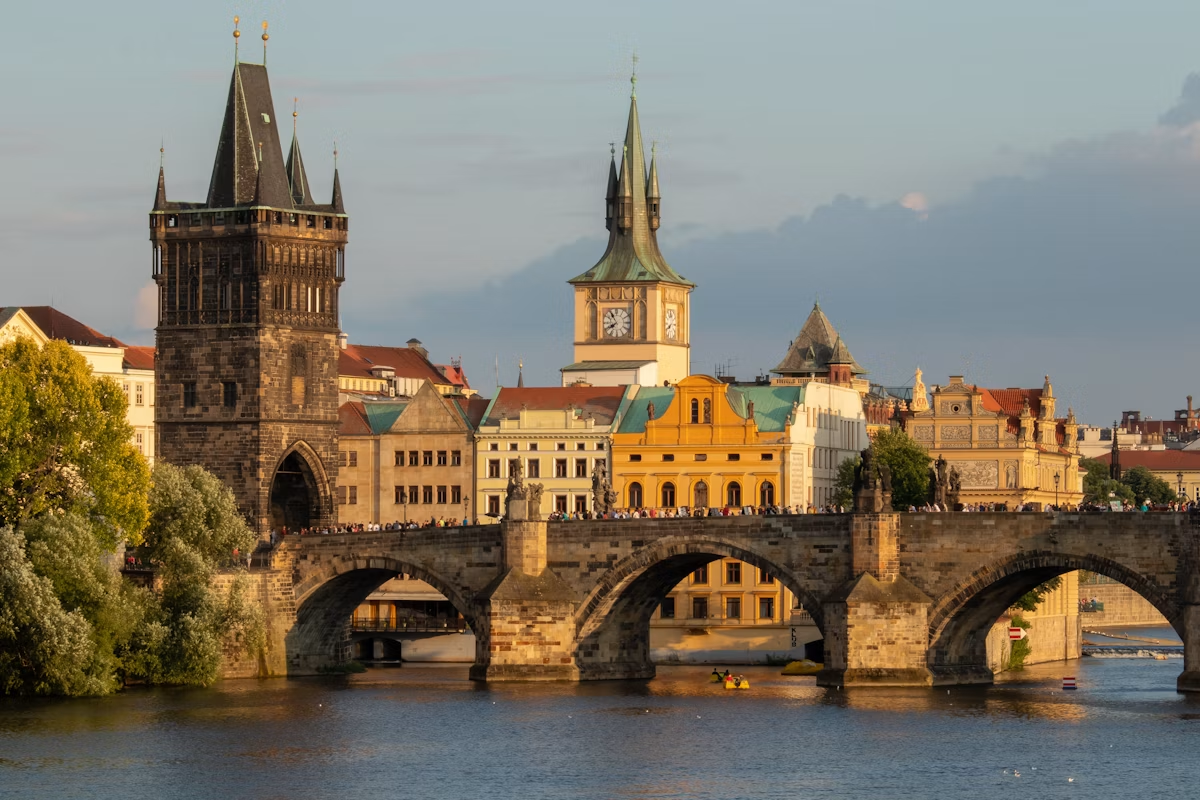
Photo by Martin Krchnacek on Unsplash
Top Free Sights for Prague Budget Travel
Charles Bridge — Free (Day and Night)
The 14th-century stone bridge connecting the Old Town to Malá Strana is Prague’s single most iconic landmark — a 516-meter Gothic structure flanked by 30 Baroque statues of saints on pedestals, with Prague Castle visible on the hill above. At dawn (5–7 AM) the bridge holds perhaps 20 people and the morning light on the castle from the bridge’s mid-point is the photograph most visitors came to take. By 9 AM it holds 2,000 people. Prague budget travel schedule tip: set the alarm and go at first light. Charles Bridge costs nothing at any hour.
Old Town Square (Staroměstské náměstí) — Free
The medieval center of Prague — a square defined by the Church of Our Lady before Týn (twin Gothic spires, 14th–15th century), the Baroque St. Nicholas Church, and the medieval Old Town Hall with its famous Astronomical Clock (Orloj). The Orloj performs a mechanical show on the hour (12 figures of the Apostles rotate past two windows above the clock face) — at peak hours the square fills with hundreds of observers. The square itself costs nothing; climbing the Old Town Hall Tower (CZK 250 / ~€10) provides the city’s best panoramic view of the Old Town roofscape.
Prague Castle (Pražský Hrad) — Free Entry to Grounds
The world’s largest ancient castle complex — a 70,000 m² hilltop site containing St. Vitus Cathedral, the Royal Palace, Golden Lane (historic craftsmen’s houses), St. George’s Basilica, and multiple gardens. Entry to the castle grounds is free; the internal circuit tickets cost CZK 250–400 ($10.87–$17.39 / €10–€16). For Prague budget travel purposes, the grounds and the exterior of St. Vitus Cathedral — one of the finest Gothic cathedrals in Europe — are free to access. The interior of St. Vitus requires a ticket, and is worth buying.
Vyšehrad — Free and Undervisited
Prague’s second fortified hill — older in mythology than the castle (Czech founding legends trace to Vyšehrad) but far less visited. The grounds are free: the Rotunda of St. Martin (11th century, Prague’s oldest surviving building), the neo-Gothic Basilica of Ss. Peter and Paul (CZK 80 / €3.20 entry), and the Vyšehrad Cemetery — the burial site of Czech artists, writers, and composers including Dvořák, Smetana, Mucha, and Čapek. The ramparts afford outstanding views south along the Vltava. Virtually no crowds, no tourist infrastructure, no admission for the grounds — the best free view in Prague budget travel itineraries.
Letná Park — Free
A broad park on a promontory above the Vltava, with a beer garden (Letná Beer Garden) that has the best city view of Prague’s roofscape from across the river. Walk up from the metro (Vltavská) or take the tram. The park is where Praguers drink on warm evenings — draft Pilsner Urquell or Bernard at CZK 55–75 ($2.39–$3.26 / €2.20–€3) per 500ml, with the cityscape below. One of the genuinely great free experiences in any Prague budget travel guide.
Josefov — The Jewish Quarter
The medieval Jewish Quarter has the highest concentration of paid attractions in the Old Town — six surviving historic synagogues and the Old Jewish Cemetery, operated as a museum complex by the Jewish Museum in Prague. Circuit ticket (all synagogues + cemetery): CZK 500 (~€20 / $21.74). The Cemetery alone — layers of tombstones stacked twelve deep due to the prohibition on Jewish burial outside the ghetto walls — is one of the most sobering historical sites in Central Europe. Not cheap by Prague budget travel standards, but essential for understanding the city’s history.
Neighborhoods Worth Exploring
Malá Strana (Lesser Town)
The baroque district beneath Prague Castle — steep cobbled streets, private palace gardens (some open May–October at CZK 100–150), embassies, and some of Prague’s best wine bars and restaurants. Quieter than the Old Town, with prices that partly reflect the residential character alongside the tourist trade.
Vinohrady
The residential neighborhood east of the New Town — Art Nouveau apartment buildings, leafy squares, a Croatian-style church (Most Sacred Heart of Our Lord, designed by Josip Plečnik), independent restaurants, and Prague’s most livable café culture. This is where Prague budget travel residents who stay more than a few days migrate to eat. Tram from the Old Town: 10 minutes.
Žižkov
Adjacent to Vinohrady, with a more working-class character and the highest pub-per-capita ratio in Europe — a genuine claim. The area’s Žižkov Television Tower (CZK 250 / €10 for the observation deck; controversial and unmissable on the skyline) is the oddest piece of architecture in Prague. The neighborhood bars serve draft beer at CZK 40–55 per 500ml ($1.74–$2.39) — substantially below Old Town prices.
Prague Budget Travel: Food Strategy
Czech cuisine is built around hearty meals with excellent beer — roast pork, dumplings, rich sauces, preserved vegetables. The single best Prague budget travel food decision is to eat at pubs (hospody) and Czech restaurants outside the Old Town tourist triangle, where prices are set for residents rather than visitors.
Essential Czech dishes:
- Svíčková na smetaně: Braised beef sirloin in cream sauce with bread dumplings, cranberries, and whipped cream — the Czech national dish. CZK 180–280 ($7.83–$12.17 / €7.20–€11.20) at good Czech restaurants. Never acceptable at less than CZK 150 in the Old Town (if it’s cheaper, it’s not good)
- Vepřo-knedlo-zelo: Roast pork with bread dumplings and braised sauerkraut — the definitive Czech pub meal. CZK 150–240 ($6.52–$10.43 / €6–€9.60)
- Řízek: Czech schnitzel — veal or pork, breadcrumbed and pan-fried. CZK 130–200 ($5.65–$8.70 / €5.20–€8.00). Best from butcher-stalls at the market on Náměstí Míru (Vinohrady)
- Guláš: Czech beef goulash — richer and more paprika-forward than Hungarian versions, served with bread dumplings. CZK 140–200 ($6.09–$8.70 / €5.60–€8.00)
- Trdelník: The chimney cake is everywhere in the Old Town — spiral pastry cooked on a rotating spit, sprinkled with sugar and cinnamon. CZK 90–150 ($3.91–$6.52 / €3.60–€6.00). A tourist product of dubious Czech authenticity, but unavoidable and often delicious
Prague beer culture: Czech Republic has the world’s highest per-capita beer consumption, and Prague is where that culture is most concentrated. Czech Pilsner (Pilsner Urquell, Budvar, Kozel) is the baseline. Draft beer in a pub outside the Old Town: CZK 40–60 ($1.74–$2.61 / €1.60–€2.40) per 500ml pint. In the Old Town: CZK 70–120 ($3.04–$5.22 / €2.80–€4.80). The quality difference rarely justifies the price premium.
Best budget eating areas: Vinohrady (tram line 4/22/23 from Old Town); Žižkov (tram line 5/9/26); Holešovice (tram line 12/17).
Day Trips from Prague
Kutná Hora (1.5 hrs by train)
A UNESCO World Heritage medieval silver mining town with two extraordinary sites: the Sedlec Ossuary (the famous “bone church” — a small chapel decorated with the bones of 40,000 people, CZK 120 / €4.80) and the Cathedral of St. Barbara (one of Central Europe’s finest Gothic cathedrals, CZK 120 / €4.80). Train from Prague Hlavní nádraží: CZK 120–170 ($5.22–$7.39 / €4.80–€6.80) return. The best Prague budget travel day trip for historical density.
Český Krumlov (3 hrs by bus)
A UNESCO-listed medieval town in southern Bohemia — a state castle on a river bend, a Baroque theater, and an intact Old Town that looks unchanged from the 16th century. FlixBus or RegioJet from Prague: €8–€15 one-way. Better as a 1–2 night stop than a day trip due to distance.
Terezín (1 hr by bus)
The 18th-century fortress town used by the Nazis as a transit concentration camp (Theresienstadt) and model “show camp” — the Terezín Memorial covers both the Small Fortress (used as a prison) and the former Jewish Ghetto. Bus from Florenc station: CZK 100 ($4.35 / €4) return. Essential historical context alongside Auschwitz for any Prague budget travel visitor covering Central European history.
Where to Stay for Prague Budget Travel
Hostels (€15–€30/night dorm)
Prague has one of Europe’s strongest hostel markets — quality ranges from party hostels near Wenceslas Square to boutique hostels in Vinohrady. Sir Toby’s Hostel (Holešovice), Hostel One Home (Žižkov), and Mosaic House Design Hostel (New Town) all offer consistent quality at Prague budget travel prices.
Budget Hotels (€55–€90/night)
Staying in Vinohrady, Žižkov, or Holešovice rather than the Old Town cuts accommodation costs by 30–50% with no practical transport penalty — the tram network puts the Old Town within 15 minutes.
Location Note
The Old Town has the best atmosphere for first-time visitors but significantly higher accommodation prices. For repeat visits or stays longer than 3 nights, Vinohrady is the better Prague budget travel base.
Getting Around Prague
Metro: 3 lines (A/B/C) covering the major areas — 25-minute single ticket (CZK 30 / €1.20) or 90-minute ticket (CZK 40 / €1.60). Prague’s metro opens at 5 AM and runs until midnight.
Tram: The tram network is more useful than the metro for tourist areas, since it runs through the historic center (metro avoids the Old Town). Line 22 is the classic tourist tram route: from Vinohrady through the New Town, across the river, up to Prague Castle. 24-hour pass: CZK 120 ($5.22 / €4.80).
Walking: The Old Town, Malá Strana, and Hradčany are all best explored on foot — the streets are pedestrian-priority and the density of interesting architecture rewards slow walking. Charles Bridge to Prague Castle: 20 minutes on foot.
Daily Budget Breakdown
| Category | Budget | Comfortable |
|---|---|---|
| Accommodation | €18 (hostel dorm) | €85 (Vinohrady hotel) |
| Food (3 meals + one beer) | €14 | €38 |
| Transport (24-hr tram pass) | €5 | €8 |
| Attractions (1–2 sites) | €8 | €22 |
| Daily Total | ~€45 | ~€153 |
Final Verdict: Prague Budget Travel in 2026
Prague rewards the traveler who treats the city as a place to inhabit rather than check off. Charles Bridge at 5:30 AM, a draft Pilsner in Letná Park with the cityscape below, svíčková at a Czech pub in Vinohrady — these are the moments that justify the trip and cost almost nothing. Prague budget travel works best when accommodation and food decisions are made deliberately (outside the Old Town tourist triangle), leaving spending capacity for the paid sites that genuinely reward entry fees: the Castle, St. Vitus, Josefov, and a day trip to Kutná Hora. Few European capitals deliver this combination of extraordinary built environment, genuine cultural depth, and accessible price point. Prague in 2026 remains one of the strongest arguments in European travel.