
Hoi An is the most atmospheric town in Vietnam and one of the finest examples of a preserved historic trading port anywhere in Southeast Asia. A UNESCO World Heritage Site since 1999, the Ancient Town retains the architecture of its 15th–18th century peak as an international merchant hub — Chinese assembly halls, Japanese merchant houses, a 16th-century covered bridge, and a French colonial overlay, all compressed into a walkable river-bend district of yellow-washed walls and paper lanterns. This Hoi An travel guide covers the Ancient Town in detail, the best beach options, the tailoring culture that makes Hoi An unique, the food scene — widely considered the best in Vietnam — and the practical logistics that make a 2–4 day visit here the highlight of many Vietnam itineraries.
At a Glance
| Country | Vietnam (Quảng Nam Province) |
| Currency | Vietnamese Dong (VND) — ~25,000 VND per $1 USD |
| Language | Vietnamese; English widely spoken in tourist areas |
| Best time | February–August (dry season; February–April is optimal) |
| Avoid | October–November (flood season; the Ancient Town can flood significantly) |
| Daily budget (frugal) | $25–$40/day |
| Daily budget (comfortable) | $55–$100/day |
| Visa | 90-day e-visa required for most nationalities; apply at evisa.xuatnhapcanh.gov.vn |
| Getting there | Fly to Da Nang (DAN) — 30 km, taxi $15–$20, or private transfer |
| Getting around | Bicycle (best), walking, motorbike |
The Ancient Town: The Heart of This Hoi An Travel Guide
Hoi An’s Ancient Town is a 30-hectare district protected under UNESCO World Heritage status — 1,300+ buildings of historic or cultural significance within a single riverside neighborhood. The architectural character reflects its history as a trading port where Japanese, Chinese, Dutch, and Portuguese merchants established permanent communities between the 15th and 19th centuries. The result is a genuinely unique built environment: Chinese merchant houses with curved roofs and open courtyards stand beside Japanese-influenced timber warehouses; the Cantonese, Fujian, and Hainan Chinese communities each built their own assembly halls (hội quán) that remain in active use.
Ancient Town ticket: VND 120,000 ($4.80) per person — covers access to 5 of 22 ticketed heritage sites (choose from a menu). The ticket is enforced at major sites but not required to walk the streets, browse shops, or visit restaurants. Purchasing the ticket supports site preservation and is recommended.
Key sites on a Hoi An travel guide itinerary:
- Chùa Cầu (Japanese Covered Bridge): Built by the Japanese merchant community in the early 17th century — the only remaining covered bridge in the country and Hoi An’s defining image. The small temple embedded in the bridge is dedicated to the deity Trấn Vũ. Free to photograph from outside; VND 120,000 ticket required for entry
- Tân Kỳ Old House (84 Trần Phú): A 200-year-old merchant residence illustrating the layered Chinese-Japanese-Vietnamese architectural synthesis of Hoi An at its peak. Guided by family members who still reside in the rear of the house; ticket required
- Phúc Kiến Assembly Hall (Fujian Chinese Assembly Hall): The most elaborate of the Chinese assembly halls — built by the Fujian Chinese community in 1697 and expanded to its current ornate form over subsequent centuries. Dedicated to Thiên Hậu (Goddess of the Sea). Free entry; one of the most visually extraordinary sites in the Ancient Town
- Museum of Sa Huỳnh Culture: Artifacts from the Sa Huỳnh civilization, which preceded Hoi An’s trading port era by 1,500+ years — useful context for understanding the depth of human settlement in this area. Ticket required
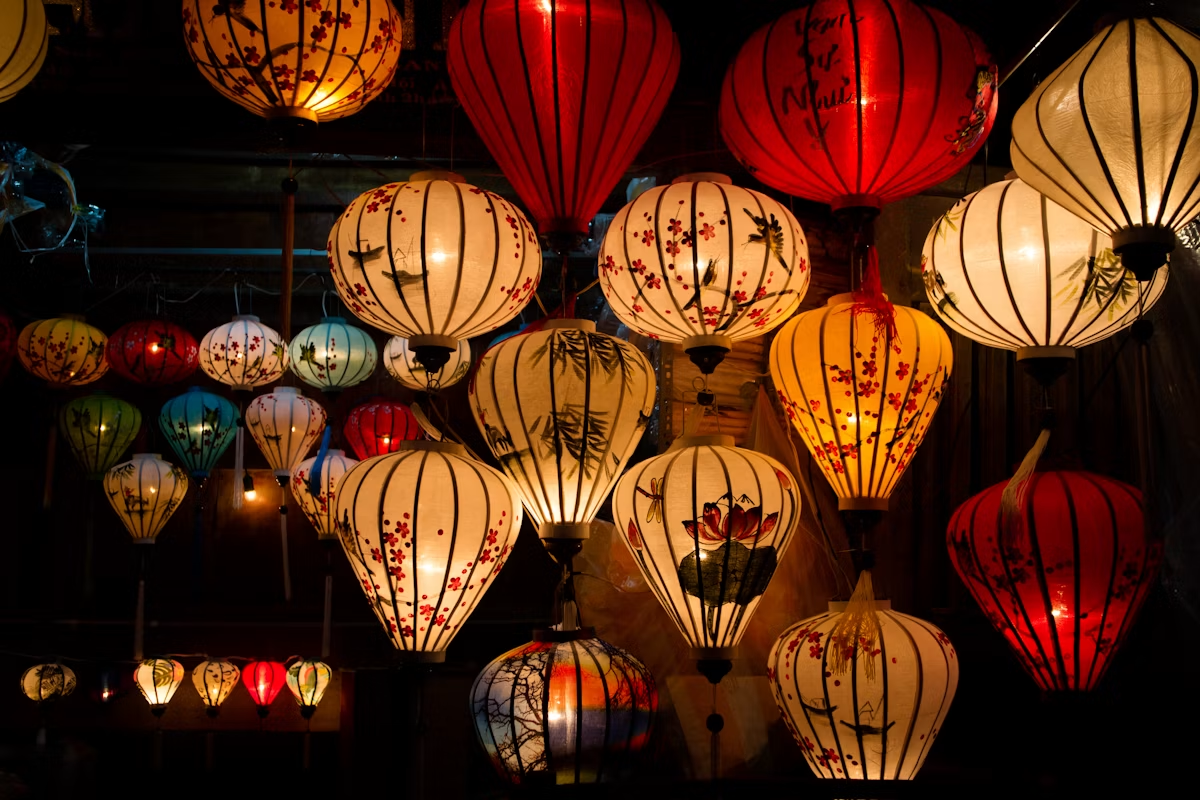
Photo by Thanh Soledas on Unsplash
Full Moon Lantern Festival
On the 14th day of each lunar month (corresponding to approximately one specific date per month in the Gregorian calendar), Hoi An holds its Lantern Festival — electric lights are switched off in the Ancient Town, and paper lanterns illuminate the streets and Thu Bon River. Lantern boats carrying candles float on the water; traditional music performances occur in the streets; the atmosphere is extraordinary.
The Lantern Festival is the single most celebrated event in any Hoi An travel guide. If your itinerary permits alignment with a festival night, it is worth planning around. Hoi An is significantly more crowded on festival nights — book accommodation well in advance if visiting during this period.
Hoi An Tailoring: A Unique Feature of Any Hoi An Travel Guide
Hoi An has more tailors per capita than any city in Asia — hundreds of shops producing custom-made clothing in 24–72 hours at prices well below Western equivalents. This tailoring culture developed from Hoi An’s history as a textile trading port and has been maintained through generations of skilled craft.
What to order: Suits, dresses, ao dai (traditional Vietnamese tunic dresses), shirts, and casual clothes are all produced competently by reputable tailors. Complex construction (structured jackets, formal suits) requires more lead time and multiple fittings.
Hoi An travel guide tailoring tips:
- Allow 48–72 hours minimum — rushed 24-hour orders sacrifice fitting quality
- Request a fitting after the initial cut and before final stitching
- Bring reference photos or a well-fitting garment to copy
- The most reputable tailors: Yaly Couture (multiple locations), A Dong Silk, Bảo Hiệu Tailors
Pricing: A tailored suit (wool blend fabric from their stock): $80–$200. A custom ao dai: $35–$80. Silk dress: $50–$120. Bespoke pricing depends heavily on fabric choice — their imported European wools cost significantly more than local Vietnamese fabric.
Hoi An Food: The Best Vietnamese Cuisine
Hoi An’s food scene is widely considered the finest in Vietnam — not for ambition or innovation, but for the distinctive local dishes that exist only here and are executed with long-practiced precision. Every Hoi An travel guide emphasizes these three dishes specifically, because nowhere else in Vietnam gets them right.
The three dishes you must eat:
Cao Lầu — Hoi An’s Signature Noodle Dish
Thick, slightly chewy rice-flour noodles in a minimal broth with pork (char siu style), bean sprouts, and crispy rice crackers. The noodles must be made with water from Hoi An’s Ba Le Well (an ancient Cham-era well) to achieve the correct texture — this is the dish that cannot be replicated outside Hoi An. VND 30,000–60,000 ($1.20–$2.40) at local restaurants; VND 80,000–120,000 ($3.20–$4.80) at tourist-facing spots.
Where to eat it: Cao Lầu Bà Bé (Trần Phú) and Morning Glory Restaurant (Trần Phú 106) are consistently excellent. Any market stall in the Central Market also serves reliable versions.
Bánh Mì Phượng — The Most Famous Bánh Mì in Vietnam
Hoi An’s Bánh Mì Phượng (26 Phan Châu Trinh) was named by Anthony Bourdain as one of the best sandwiches in the world — a baguette split and filled with pâté, cold cuts, pickled daikon and carrot, cucumber, chili, and herbs. The bread is lighter and crispier than Saigon versions. VND 30,000–45,000 ($1.20–$1.80). The queue begins forming at 7 AM.
White Rose Dumplings (Bánh Bao Vạc)
Translucent shrimp dumplings resembling folded white roses — a dish produced almost exclusively by a single family who supply most restaurants in the Ancient Town. The preparation is delicate, the flavor subtle. VND 60,000–90,000 ($2.40–$3.60) for a plate at restaurants in the Ancient Town.
Other essential eating:
- Cơm Gà Hội An (Hoi An Chicken Rice): Fragrant turmeric rice topped with shredded poached chicken, fried shallots, and herbs. VND 40,000–70,000 ($1.60–$2.80)
- Mì Quảng: Central Vietnamese noodle dish with turmeric-infused broth, pork, shrimp, and crushed peanuts. VND 30,000–55,000 ($1.20–$2.20)
- Bánh Xèo: Crispy Vietnamese sizzling crepe filled with shrimp, pork, and bean sprouts — eaten wrapped in lettuce and rice paper. VND 50,000–80,000 ($2.00–$3.20)
Food areas: The Central Market (Chợ Hội An) — fresh produce, local vendors, morning activity; Trần Phú street — restaurant density; Nguyễn Thị Minh Khai street — local price restaurants away from tourist premium.
Beaches Near Hoi An
An Bàng Beach (5 km from Ancient Town)
An Bàng is the beach most Hoi An travel guide writers recommend for good reason: wide, sandy, relatively uncrowded compared to Da Nang’s tourist strip, and with a cluster of good beach bars and restaurants that make a half-day here genuinely pleasant. Bicycle from the Ancient Town: 20 minutes. Motorbike: 10 minutes.
Beach clubs and restaurants: Soul Kitchen and An Bàng Beach Bar are the established options — sun loungers with umbrellas: VND 50,000–100,000 ($2.00–$4.00) per person; beers: VND 30,000–50,000 ($1.20–$2.00). Swim conditions are good February–August; flag system in operation.
Cửa Đại Beach (5 km east of Ancient Town)
Closer to town but has suffered significant erosion in recent years — the beach is narrower than An Bàng and the sand quality is lower. Fine for a short swim but An Bàng is the better Hoi An travel guide recommendation for a dedicated beach day.
Day Trips from Hoi An
My Sơn Sanctuary (40 km, 1 hour)
A group of partially ruined Cham Hindu temple towers built between the 4th and 14th centuries — a UNESCO World Heritage Site representing the Cham Kingdom that preceded Vietnamese control of central Vietnam. Entry: VND 150,000 ($6.00). Guided tours from Hoi An: $15–$25 per person including transport. The early morning (open at 6:30 AM) has the best light and fewest crowds.
Da Nang (30 km, 45 minutes by taxi)
Vietnam’s third-largest city with a more developed infrastructure than Hoi An — international airport, large supermarkets, Marble Mountains (a cluster of limestone hills with caves and temples, VND 40,000 / $1.60 entry), and the Dragon Bridge (which breathes fire and water on weekend nights). Taxi from Hoi An: $15–$20.
Getting Around Hoi An
Bicycle: The optimal Hoi An travel guide transport — flat terrain, compact distances, and a cycling culture that makes it the most natural way to move between the Ancient Town, beaches, and surrounding countryside. Rental: VND 60,000–120,000 ($2.40–$4.80)/day from guesthouses or street shops.
Walking: The Ancient Town itself is best explored on foot — the streets are narrow, partially pedestrianized, and the density of architecture rewards slow movement.
Motorbike: VND 100,000–150,000 ($4.00–$6.00)/day for day trips to My Sơn or Da Nang. Valid international driving permit required in theory; enforcement is inconsistent.
Grab (ride-hailing): Available in Hoi An for trips that exceed comfortable cycling range.
Where to Stay in Hoi An
Budget (VND 150,000–400,000 / $6.00–$16.00/night)
The area just west of the Ancient Town (Cẩm Châu) has the best budget guesthouses — family-run properties with breakfast included, bicycles, and garden settings at prices well below Ancient Town accommodation. Anio Boutique Hostel and Sunflower Hoi An Hotel consistently receive strong reviews at this price point.
Mid-Range (VND 600,000–1,500,000 / $24.00–$60.00/night)
Hoi An has an extraordinary mid-range hotel market for its size — boutique pool villas, ancient townhouse conversions, and resort-style garden hotels within cycling distance of the Ancient Town. La Siesta Resort and Hoian Chic Hotel represent good value in this category.
Location Guidance
Staying within the Ancient Town itself provides the best atmosphere (especially for Lantern Festival nights) but at premium prices. The west side of the Ancient Town (Cẩm Nam neighborhood across the footbridge) offers a quieter and cheaper alternative within easy walking distance.
Daily Budget Breakdown
| Category | Budget | Comfortable |
|---|---|---|
| Accommodation | $12 (guesthouse) | $55 (boutique hotel) |
| Food (3 meals) | $10 | $30 |
| Ancient Town ticket | $4.80 | $4.80 |
| Transport (bicycle) | $4 | $4 |
| Activities / misc | $5 | $20 |
| Daily Total | ~$36 | ~$114 |
Final Verdict: Hoi An Travel Guide 2026
Hoi An earns its reputation — the Ancient Town at dusk, lanterns reflected in the Thu Bon River, cao lầu eaten at a market table for $2, a tailored linen shirt collected the morning of departure. This Hoi An travel guide’s core recommendation is 3 full days minimum: enough time to cover the Ancient Town properly, eat every dish once (and the best ones twice), spend a half-day at An Bàng, and make one day trip to My Sơn or the broader Da Nang region. Hoi An is more touristic than it was a decade ago, but the fundamentals that drive its appeal — the architecture, the food specificity, the tailoring culture — remain intact and genuinely justify the visit. For any Vietnam itinerary, Hoi An is non-negotiable.