
Chefchaouen is Morocco’s most photographed city — a mountain medina in the Rif Mountains whose streets, staircases, window frames, flower pots, and walls have been painted in gradations of blue for the better part of a century, creating an environment unlike anything else in North Africa or the Mediterranean. The reasons the Blue City is blue are multiple and contested: some historians attribute it to Jewish refugees from Spain in the 1400s (blue is symbolic in Jewish tradition); others to a municipal painting campaign after Moroccan independence; others to a practical function in repelling insects. What is undeniable is the effect — walking through Chefchaouen’s medina on a clear morning, the blue walls against the terracotta rooflines and the Rif Mountain backdrop, is one of the most visually compelling experiences in Africa. This Chefchaouen travel guide covers the medina in full, the mountain hiking access, the Moroccan food scene, practical logistics from Fes and Tangier, and a complete budget breakdown. The city is smaller than most visitors expect and more rewarding than most Chefchaouen travel guide reviews communicate.
At a Glance
| Country | Morocco |
| Currency | Moroccan Dirham (MAD) — ~10 MAD per $1 USD |
| Language | Arabic and Darija (Moroccan Arabic); Tarifit Berber in the Rif region; French; Spanish; limited English |
| Best time | March–May and September–November (mild, clear, fewer tourists than summer) |
| Avoid | July–August (peak crowds, intense heat 35°C+; expensive accommodation) |
| Daily budget (frugal) | $25–$40/day |
| Daily budget (comfortable) | $55–$100/day |
| Visa | Visa-free entry for US, EU, UK, Canadian, and Australian passport holders (90 days) |
| Getting there | Bus from Tangier (3 hrs, MAD 50/$5), Fes (3.5 hrs, MAD 75/$7.50), or Casablanca (6 hrs, MAD 100/$10) via CTM or Supratours |
| Getting around | Walking (the medina is compact); petit taxi for surrounding areas |
Why Chefchaouen Is Different from Any Other City
Chefchaouen is not a city that takes a full week to understand — it is a single medina, concentrated, that rewards the specific kind of slow, purposeless walking that most travel itineraries actively resist. The medina covers approximately 1 square kilometer of hilly terrain above the Oued Laou river valley, with the Rif Mountains rising on both sides. The main plaza — Plaza Uta el-Hammam — anchors the commercial and social center, and the medina radiates from it up narrow alleys that double back, dead-end in private doorways, and reconnect unexpectedly.
The photography opportunity is constant and well-known; what is less discussed in any Chefchaouen travel guide is the quality of life within the medina — the genuine quiet by 9 PM when the day-trippers have left for Fes or Tangier, the quality of the fresh goat cheese sold from small carts in the morning market, the sound of the call to prayer from the Grand Mosque reverberating between blue walls at sunrise. Chefchaouen rewards staying two or three nights rather than arriving on a day trip from Fes — the early mornings before 8 AM and the late evenings after 7 PM belong to the city itself.
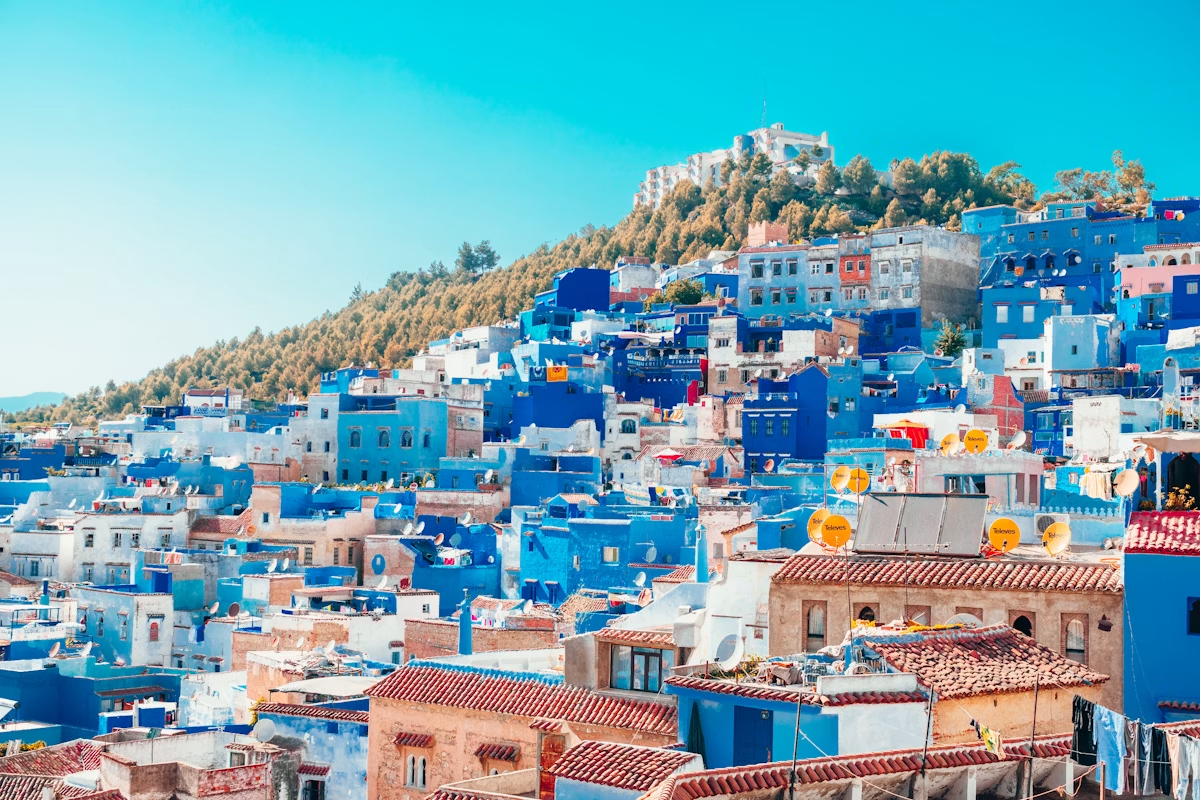
Photo by Heidi Kaden on Unsplash
The Blue Medina: Walking the Chefchaouen Travel Guide Route
The medina’s blue color is not uniform — it shifts from the intense cobalt of main lanes to faded powder blue in residential alleys, from pure indigo on recently repainted walls to slate-grey where the paint has aged and weathered. Part of what makes the Chefchaouen travel guide photography experience rewarding beyond Instagram is the variety within the blue: textures, gradients, combinations with terracotta pots, orange cats, and the occasional red-and-white tile inlay.
Key areas within the medina:
- Plaza Uta el-Hammam: The main square — an octagonal plaza anchored by the 15th-century Grand Mosque (closed to non-Muslims) and the Kasbah (converted to a small ethnographic museum, MAD 10 / $1). The plaza’s cafés are the social center of medina life; the terrace of Café Clock or Café Tissekmad provides a view over the rooftops and the minaret. The best Chefchaouen travel guide orientation point
- Rue Targhi / Rue Sidi Abid: The two main commercial lanes from the plaza — lined with textile shops, leather goods, argan oil vendors, and the souvenirs that have defined the medina’s retail for decades. Prices are negotiable at virtually every stall; the first price is a minimum 30% above the expected final price
- Ras el-Maa: The old washing point at the northern edge of the medina — a natural spring where women historically washed laundry and children still swim in the pools. A functional public space that sits outside the tourist circuit and provides the most genuine glimpse of medina life in any Chefchaouen travel guide. Free; best visited in the late afternoon
- The upper residential alleys: Above Plaza Uta el-Hammam, the lanes become narrower, the blue deeper, and the tourists thinner. The cats (Chefchaouen has an extraordinary density of well-fed medina cats) become the primary navigational reference. These upper alleys, ending at the walls overlooking the Rif valley, provide the best photography in the Chefchaouen travel guide at dawn
The Spanish Mosque and Rif Mountain Views
A 20-minute uphill walk from the medina’s north exit leads to the Spanish Mosque — a small, incomplete mosque built during the Spanish protectorate period (1912–1956) that was never finished and has never been used for worship. The mosque itself is less remarkable than the position it occupies on the hillside directly above the medina.
From the Spanish Mosque plateau, the view encompasses the entire Chefchaouen medina below — the blue rooflines, the Grand Mosque minaret, the red tile of the Kasbah walls, and the Rif Mountain ridgelines extending in both directions. This is the Chefchaouen travel guide viewpoint for sunset photography — arrive 45 minutes before sunset to find a position on the hillside; dozens of photographers compete for angles in peak season but the view absorbs the crowd. The path is steep in places; wear appropriate footwear.
Practical note: The path from the medina’s Bab Onsar gate to the mosque is well-marked but becomes rougher on the final section. A one-way walk takes 20–25 minutes. Admission to the mosque grounds is free.
Why Is Chefchaouen Blue? A Brief History
Every Chefchaouen travel guide engages with this question, and the honest answer is that the blue is historically recent, multiply explained, and possibly the result of overlapping causes rather than a single origin.
Chefchaouen was founded in 1471 by Moorish refugees expelled from Spain and by Idrisid Sharifs of the royal lineage — a defensive stronghold in the Rif Mountains against Portuguese coastal expansion. For its first four centuries, the city was largely closed to non-Muslims: most European visitors in the 18th and 19th centuries who attempted entry were expelled or imprisoned.
The blue painting tradition is generally dated to the 1930s–1950s, after the arrival of Jewish refugees from Spain (who carried blue’s symbolic associations from Jewish tradition) and consolidated during the Spanish protectorate period. After Moroccan independence in 1956 and the departure of most of the Jewish community, the tradition was maintained and expanded by the remaining population, becoming increasingly associated with the city’s identity.
The current blue is not heritage-preserved in any official sense — residents repaint their sections of wall when the paint fades, choosing their preferred shades from the blue-to-white spectrum. The medina’s color is continuously maintained and continuously evolving.
Hiking in the Rif Mountains
Chefchaouen’s position in the Rif Mountains makes it a Chefchaouen travel guide destination not only for medina photography but also for day hiking into terrain that most Morocco visitors never reach.
Talassemtane National Park: Directly adjacent to the city, the park covers 580 km² of Rif Mountain cedar forest and limestone formations. Entry is free; the park administration in Chefchaouen can provide trail maps.
Key hiking routes:
- Jebel El Kelaa: A 5–6 hour round-trip hike to the summit at 1,624 meters above sea level — full views of the medina, the Rif range, and on clear days the Mediterranean coast. Trail begins from the Spanish Mosque. No guide required but recommended for first-time hikers; guides available from MAD 200–300 ($20–$30) per group from the medina entrance
- Bridge of God (Pont de Dieu / Akhchour): A natural rock arch above a turquoise swimming canyon 28 km from Chefchaouen — reachable by grand taxi (MAD 30/$3 per person) and a 2-hour return hike through forest and river. The canyon swimming in summer is among the best accessible wild swimming in Morocco
- Half-day Rif Forest Walk: A 2–3 hour loop from the medina through the Rif cedar forest — flat enough for any fitness level, providing the tree cover and mountain quiet that the medina doesn’t offer
Moroccan Food in Chefchaouen
Chefchaouen’s food is Moroccan mountain cooking with Rif Berber and Andalusian influences — simpler and less spiced than Marrakech, fresher in ingredient quality due to the mountain produce supply, and with Spanish influences visible in the olive oil usage and certain pastry preparations.
Essential Chefchaouen travel guide eating:
- Msemen: Square, flaky pan-fried flatbread folded with argan oil or honey — the Rif mountain breakfast staple. MAD 5–10 ($0.50–$1.00) from medina breakfast stalls; best eaten fresh from the griddle with a glass of Moroccan mint tea (atay)
- Harira: Tomato, lentil, and chickpea soup thickened with flour and egg, flavored with cinnamon, ginger, and fresh coriander — Morocco’s universal soup, served with dates at the breaking of the Ramadan fast and as a daily lunch elsewhere. MAD 10–20 ($1.00–$2.00) from small medina restaurants
- Kefta Tagine: Ground beef or lamb with cumin, coriander, and paprika, cooked in a clay tagine with eggs and tomato — a complete dish for MAD 40–70 ($4.00–$7.00) at medina restaurants. The best versions use the local Rif mountain lamb
- Goat Cheese: Fresh local goat cheese (jben) from the Rif — sold from handcarts in the early morning market near the medina entrance, and available at the Ras el-Maa washing area vendors. One of the most underrated Chefchaouen travel guide food finds — eaten with bread and honey or crumbled over harira
- Bastilla: Pigeon or chicken in paper-thin warqa pastry with almonds and sugar — the Moroccan baroque pastry from Fes that appears on most Chefchaouen restaurant menus for special occasions. MAD 80–150 ($8.00–$15.00) as a starter
- Mint Tea (Atay): The social lubricant of the entire country — green tea (gunpowder Chinese tea) steeped with fresh spearmint and sugar, poured from height to aerate. Never ordered; always offered. The correct Chefchaouen travel guide posture is to accept at least three glasses in any negotiation and most conversations
Day Trips from Chefchaouen
Tangier (3 hrs by bus, MAD 50)
Morocco’s gateway city and northern port — a cosmopolitan city of the Beat Generation literary history (Burroughs, Ginsberg, and Kerouac wrote there), the Kasbah des Caids with views across the Strait of Gibraltar, and the Legzira Beach arched sea cliffs accessible on a day extension. The most common Chefchaouen travel guide arrival or departure routing; many visitors arrive by ferry from Spain to Tangier, bus to Chefchaouen, then continue south.
Fes (3.5 hrs by bus, MAD 75)
The UNESCO-listed medina of Fes el Bali is the largest car-free urban area in the world and Morocco’s most complex city — the tanneries, the Bou Inania Madrasa, the Chouara leather quarter, the Medersa Bou Inania. Many Chefchaouen travel guide itineraries combine 2 nights in Chefchaouen with 2 nights in Fes as part of the Imperial Cities route. The Fes medina is an overwhelming contrast to Chefchaouen’s quiet blue lanes.
Volubilis (from Fes or Meknès)
The best-preserved Roman ruins in Morocco — a 3rd-century BCE Berber capital later occupied by Rome, with triumphal arches, floor mosaics, and olive presses visible across a hill above the Oued Khoumane valley. Entry: MAD 70 ($7.00). Best combined with a night in Meknès on the Fes routing.
Where to Stay in Chefchaouen
Budget (MAD 120–250 / $12–$25/night)
The medina has an excellent budget riad and guesthouse market — small family-run accommodations in traditional houses with terrace access and often breakfast included. Dar Meziana, Dar El Kelaa, and the cluster of budget guesthouses near Bab Onsar provide clean, atmospheric accommodation at the lowest price point.
Mid-Range (MAD 350–700 / $35–$70/night)
Boutique riads in converted medina houses — terrace breakfasts with Rif mountain views, private bathrooms, and the hospitality standard Chefchaouen is known for. Casa Perleta, Riad Cherifa, and Dar Echchaouen are well-reviewed mid-range options with rooftop access and mountain views.
Upscale (MAD 800–1,500+ / $80–$150+/night)
A small number of premium riads offer spa services, swimming pools (exceptional given the medina location), and hotel-standard service within traditional Moroccan architecture. Lina Ryad & Spa is the benchmark upscale Chefchaouen travel guide accommodation.
Getting Around Chefchaouen
Walking: The medina is the entire travel experience — every Chefchaouen travel guide destination within the city is reachable on foot in under 15 minutes. Street quality is uneven (cobblestones, steep lanes, occasional construction) — comfortable walking shoes are essential.
Petit Taxi: The blue shared taxis serving Chefchaouen — flagged on the main road below the medina for destinations in the Rif area. MAD 10–30 ($1.00–$3.00) per person for most journeys. Use for Akhchour canyon trips (shared taxi MAD 30/$3.00 per person) or to reach Akchour and the bridge.
Grand Taxi and CTM Bus: For onward travel to Fes (MAD 75 / $7.50 by CTM bus) and Tangier (MAD 50 / $5.00) — the CTM station is at the base of the medina road.
Daily Budget Breakdown
| Category | Budget | Comfortable |
|---|---|---|
| Accommodation | $15 (guesthouse) | $60 (boutique riad) |
| Food (3 meals + tea) | $10 | $28 |
| Transport | $3 | $8 |
| Activities / hiking / entry fees | $5 | $15 |
| Daily Total | ~$33 | ~$111 |
Final Verdict: Chefchaouen Travel Guide 2026
Chefchaouen rewards patience and rewards early risers. The city’s visual drama — the blue walls, the mountain backdrop, the cats, the morning light at 7 AM on the upper alley staircases — is genuine and not exaggerated by the photographs that made the medina famous. The crowds are real between 10 AM and 5 PM in peak season (July–August, Easter, Christmas), but they dissipate in the mornings and evenings completely. The ideal Chefchaouen travel guide itinerary is two nights minimum: one evening to arrive and walk the medina at sunset, one full day for the Spanish Mosque at dawn, the medina at leisure, and the Ras el-Maa waterfall in the afternoon, and a second evening to eat well and sit in Plaza Uta el-Hammam without itinerary pressure. Travelers who stay three nights can add the Akhchour canyon day trip and a half-day Rif forest hike — expanding the Chefchaouen travel guide experience from a single medina to a mountain destination with both photographic and outdoor depth.