
Osaka is Japan’s second city in energy if not in official ranking — the place where Japanese food culture reaches its most exuberant expression, where the nightlife district of Dotonbori lights the Shinsaibashi canal in neon from dusk until 3 AM, and where the local identity (“kuidaore” — eat until you drop) is enacted so sincerely that the city has developed its own food vocabulary for what it means to cook, eat, and enjoy. Tokyo is Japan’s political and financial capital. Kyoto is its cultural and spiritual center. But Osaka is Japan’s kitchen, its entertainment district, and the city that most rewards visitors who come specifically to eat, drink, walk, and repeat. This Osaka travel guide covers Dotonbori, Osaka Castle, the Shinsekai district, the street food culture in full detail, day trips to Kyoto and Nara, and a practical budget breakdown for 2026. Osaka is different from every other Japanese city, and no other Osaka travel guide covers it the same way twice.
At a Glance
| Country | Japan |
| Currency | Japanese Yen (JPY) — ~155 JPY per $1 USD |
| Language | Japanese; Osaka dialect (Kansai-ben) is distinctive; English available in tourist areas |
| Best time | March–May (cherry blossoms, mild weather) and October–November (autumn foliage, cool) |
| Avoid | July–August (humid, 33–37°C; typhoon risk in August–September) |
| Daily budget (frugal) | $40–$65/day |
| Daily budget (comfortable) | $90–$160/day |
| Visa | 90-day visa-free entry for US, EU, UK, Australian passport holders |
| Getting there | Fly to Kansai International Airport (KIX) — Haruka Express to Shin-Osaka: 80 min, ¥2,930 ($18.90); or Osaka Namba via Nankai Line: 38 min, ¥1,210 ($7.81) |
| Getting around | Osaka Metro (subway), JR Loop Line, walking |
Dotonbori: The Heart of Every Osaka Travel Guide
Dotonbori is the district that defines Osaka’s image in the world — a stretch of the Dotonbori canal in the Namba district surrounded by six-story neon signs, mechanical crabs waving their claws above seafood restaurants, the Glico running man illuminated above the canal, takoyaki stalls with lines 20 people deep, and a density of food-and-drink energy that is without parallel in Japan. Every Osaka travel guide begins here because Dotonbori is where Osaka’s personality is most concentrated and most legible.
The canal runs east–west for about 400 meters, accessible from the parallel streets of Shinsaibashi (shopping) to the north and Sennichimae (electronics and food) to the south. The Ebisu Bridge crossing the canal at the midpoint — known as “Glico Man Bridge” — is the Osaka travel guide center of gravity: the view east from the bridge takes in the iconic Glico sign, the Kani Doraku crab, and a wall of neon that is recognizable from a thousand photographs.
What to do in Dotonbori:
- Walk both banks: The north promenade (Tombori River Walk) and south bank have different food and entertainment concentrations — walk both before choosing where to eat
- Eat takoyaki: The octopus ball — Osaka’s most famous street food — is best consumed standing at one of the original stalls (Aizuya, Kukuru, or Doraku). The batter-fried exterior, molten interior, and combination of bonito flakes, green onion, dried bonito, mayonnaise, and Worcestershire-based sauce is the complete Dotonbori experience. ¥600–¥900 ($3.87–$5.81) for 6–8 balls
- Photograph at night: Dotonbori transforms after dark — the neon signs are designed for the night, and the best photography window is 8–11 PM
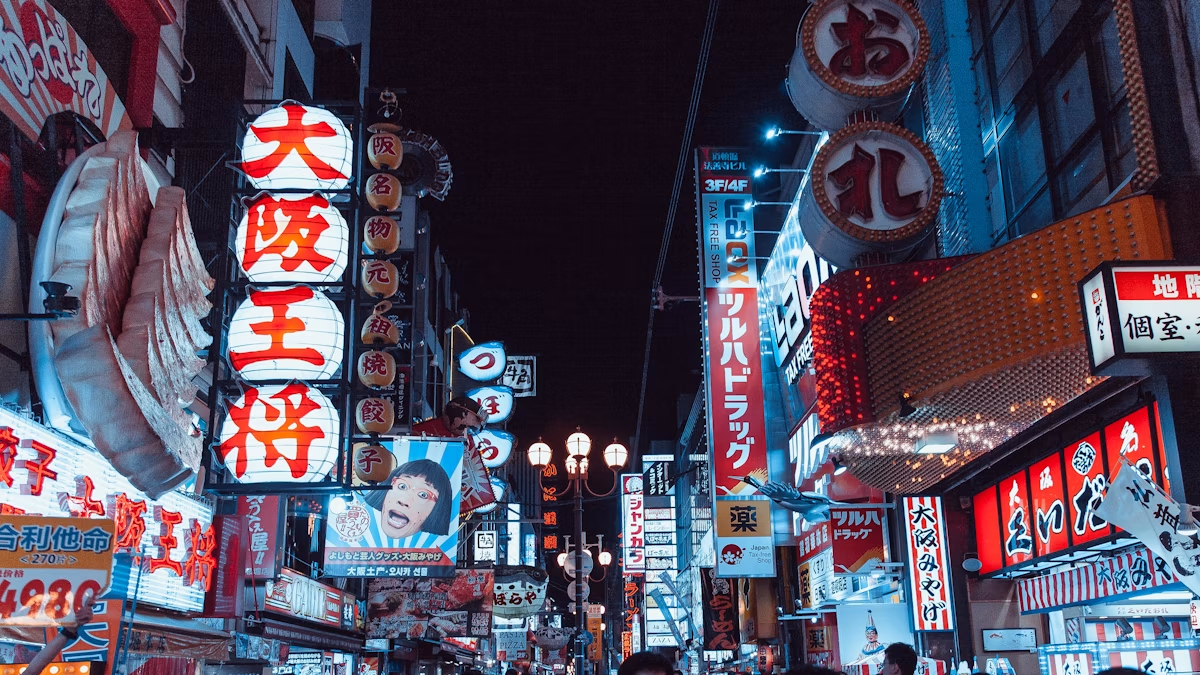
Photo by Alexander Smagin on Unsplash
Osaka Castle
Osaka Castle (Osaka-jo) is one of Japan’s most famous landmarks — a 16th-century fortress built by Toyotomi Hideyoshi in 1583 as the political and military center of a unified Japan, destroyed by fire in 1615, rebuilt in 1620s, struck by lightning in 1665, and reconstructed in concrete in 1931 (with the interior converted to a history museum). The current structure is a concrete replica with an elevator, but the eight-story castle keep is visually commanding and the surrounding park — Osaka Castle Park — is one of the finest in Japan.
What to see:
- Castle tower exterior: Most impressive from the Nishimaru Garden (¥200 / $1.29 entry) — a lawn with the full castle keep and the original stone walls. The best cherry blossom photography spot in Osaka during late March–early April
- Castle tower interior (museum): Eight floors of Toyotomi Hideyoshi history — maps, weapons, artifacts, painted screens — culminating in a panoramic observation deck on the eighth floor. ¥600 ($3.87) entry
- Osaka Castle Park: 105 hectares of moats, stone walls, and gardens free to access year-round. Morning walks along the inner and outer moats before the museum opens are among the quietest and most beautiful experiences in any Osaka travel guide
Getting there: Osaka Metro Chuo Line to Tanimachi 4-chome, or JR Loop Line to Osakajokoen station. Free park entry; castle tower museum ¥600 ($3.87).
Shinsekai and Tsutenkaku Tower
Shinsekai (“New World”) is Osaka’s retro working-class district — a neighborhood built in 1912 to imitate Paris (north half) and New York’s Coney Island (south half), fallen into post-war decline, and now a preserved pocket of 1950s atmosphere with kushikatsu restaurants, mahjong parlors, the Tsutenkaku Tower, and a distinctly non-tourist-polished character.
Tsutenkaku Tower — a 100-meter tower modeled after the Eiffel Tower and standing since 1956 — is the Osaka travel guide symbol of Shinsekai and the district’s visual anchor. Observatory deck: ¥800 ($5.16). The tower’s ground-level area is lined with kushikatsu restaurants and pachinko parlors that capture the Showa-era Osaka atmosphere.
Kushikatsu is the Shinsekai specialty — skewered meat, seafood, and vegetables, breaded and deep-fried in oil, served with a communal dipping sauce (do not double-dip — this is the single rule of kushikatsu etiquette, enforced by signage in every restaurant). ¥100–¥200 ($0.65–$1.29) per skewer; a full meal of 10–12 skewers runs ¥1,200–¥2,000 ($7.74–$12.90).
Osaka Food: The Core of Every Osaka Travel Guide
Osaka’s food identity is the reason the phrase “kuidaore” exists — the concept of eating oneself into bankruptcy, applied to a city that takes street food, market food, and restaurant food equally seriously. For any Osaka travel guide reader, the food is not peripheral to the visit; it is the primary structure around which the rest is organized.
Takoyaki
The octopus ball is Osaka’s defining contribution to Japanese food culture — a batter made from dashi fish stock poured into a specialized cast-iron mold with a half-sphere cavity, with pieces of octopus, pickled ginger, and green onion inside, rotated continuously until the exterior is crispy and the interior molten. Finished with a sweet Worcestershire-based sauce, Japanese mayonnaise, bonito flakes, and dried seaweed powder. The Osaka travel guide mandatory first food experience. ¥600–¥900 ($3.87–$5.81) for a plate of 6–8 at Dotonbori stalls.
Okonomiyaki
The Osaka-style savory pancake — a batter of grated nagaimo yam, cabbage, dashi, and egg mixed with pork belly, shrimp, or squid, cooked on a teppan griddle and finished with okonomiyaki sauce, mayonnaise, bonito flakes, and aonori seaweed. The name means “cook what you like” — variations are endless. At restaurants, you typically cook your own at a table-embedded griddle. ¥900–¥1,600 ($5.81–$10.32) at Ukiyo or Mizuno in the Dotonbori area.
Kushikatsu
Shinsekai’s deep-fried skewers, covered above, are the second pillar of any Osaka travel guide food itinerary. The breadcrumb coating here is lighter than tempura, and the range of ingredients skewered — asparagus, lotus root, mochi, sausage, crab claw, quail egg — goes well beyond the standard meat-and-vegetable categories.
Fugu (Puffer Fish)
Osaka is Japan’s fugu capital — the city that consumes more of this potentially lethal fish than anywhere else, and where the most skilled fugu chefs operate. A licensed fugu restaurant serves sashimi, shabu-shabu, and hot pot versions of this delicate, gelatinous white fish whose liver contains enough tetrodotoxin to kill a human. The flavor is mild and extraordinary delicate; the thrill is the context. Set menus from ¥5,000–¥15,000 ($32.26–$96.77). Zuboraya in Dotonbori is the most famous but not the best; ask at your accommodation for the best licensed fugu counter.
Kaiten Sushi (Conveyor Belt Sushi)
Osaka is where kaiten sushi (conveyor belt sushi) was invented — Yoshinobu Shiichiro opened the world’s first rotating sushi restaurant in Osaka in 1958. The category has diversified enormously since: the top Osaka kaiten sushi chains (Choshimaru, Ganko, Sushiro) now offer quality that rivals sit-down establishments at ¥100–¥500 ($0.65–$3.23) per plate. The Osaka travel guide recommendation for the best value sushi in Japan is a well-chosen kaiten counter.
Universal Studios Japan
Universal Studios Japan (USJ) in the Konohana district of Osaka is the most visited theme park in Japan and the fourth most visited globally. The Wizarding World of Harry Potter remains the headline attraction, but the park’s ongoing expansion — the Nintendo World, the Mario Kart attraction, and the Demon Slayer, Attack on Titan, and One Piece seasonal areas — makes USJ a full-day commitment for virtually any visitor.
Osaka travel guide logistics for USJ:
- Entry: ¥8,600–¥10,400 ($55.48–$67.10) for standard day tickets; Express Pass 7 (all major attractions): ¥16,000+ ($103.23)
- Timing: Weekday entry significantly shorter queuing than weekends; park opens at 8:30 AM for early entry ticket holders
- Getting there: JR Loop Line to Universal City station — 15 minutes from Osaka Station, ¥180 ($1.16) one-way
- Best strategy: Harry Potter area opens before general park opening; arrive for early entry, complete Potter, then move to Nintendo World before the main entry crowds reach these areas
Day Trips from Osaka
Kyoto (40 mins by Shinkansen or 75 mins by express)
The Osaka travel guide cannot discuss day trips without leading with Kyoto — Japan’s ancient imperial capital, with Fushimi Inari’s 10,000 torii gates, Kinkaku-ji’s Gold Pavilion, Arashiyama bamboo grove, and Gion’s preserved machiya townhouses. Shinkansen from Shin-Osaka: ¥1,490 ($9.61) one-way, 13 minutes. Hankyu express from Umeda: ¥410 ($2.65), 75 minutes. Most Osaka visitors make at least one Kyoto day trip.
Nara (40 mins by Kintetsu express)
The first permanent capital of Japan (710–784 CE) — Nara Park is home to approximately 1,200 freely roaming sika deer (considered sacred messengers of the gods), and the Todai-ji temple houses the world’s largest bronze Buddha (15 meters high). Entry to Todai-ji: ¥800 ($5.16). Kintetsu Nara Line from Osaka Namba: ¥680 ($4.39), 40 minutes. A half-day is sufficient; combine with a Kyoto evening.
Himeji (30 mins by Shinkansen)
Himeji Castle is Japan’s finest surviving feudal fortress — a UNESCO World Heritage Site and National Treasure known as the White Heron Castle for its soaring white walls. Completely authentic (survived World War II bombing, earthquake, and reconstruction), it is the castle that all of Japan’s reconstructed concrete castles attempt to approximate. Entry: ¥1,000 ($6.45). Shinkansen from Shin-Osaka: ¥2,970 ($19.16) one-way, 30 minutes.
Kobe (30 mins by JR)
The port city northwest of Osaka — known for the world’s most expensive beef, a French-influenced harbor district (Kitano-cho), Chinatown, and the waterfront Harborland development. Kobe beef tasting sets: ¥5,000–¥12,000 ($32.26–$77.42) at licensed restaurants. JR from Osaka to Kobe: ¥420 ($2.71), 30 minutes.
Where to Stay in Osaka
Budget (¥2,500–¥7,000 / $16.13–$45.16/night)
Osaka has one of Japan’s best hostel markets — Dotonbori-area and Shinsaibashi-area hostels provide capsule and dormitory options steps from the main food and nightlife districts. Cross Hotel Osaka and The Millennials Shibuya are well-reviewed in the budget-to-mid tier.
Mid-Range (¥8,000–¥20,000 / $51.61–$129.03/night)
The Namba and Shinsaibashi areas have a dense concentration of business hotels (APA, Dormy Inn, Vessel) with private rooms at mid-range prices. The best Osaka travel guide recommendation for first-time visitors is a mid-range business hotel in the Namba area — central, quiet, and within walking distance of Dotonbori.
Getting Around Osaka
Osaka Metro: Eight subway lines covering the entire city — the Midosuji Line (running north–south through Umeda/Shinsaibashi/Namba/Tennoji) is the spine of daily Osaka travel. Single fares: ¥180–¥360 ($1.16–$2.32). The Osaka Amazing Pass (¥2,800/$18.06 for 1 day) includes unlimited subway rides and free entry to 40+ attractions.
JR Loop Line: Connects the outer ring of neighborhoods including USJ access and Osaka Castle Park (Osakajokoen station).
Walking: Central Osaka (Dotonbori to Shinsaibashi to Namba to Shinsekai) is walkable — the densest food and entertainment concentration in any Osaka travel guide is within a 30-minute walk.
Daily Budget Breakdown
| Category | Budget | Comfortable |
|---|---|---|
| Accommodation | ¥3,500 (hostel/capsule) | ¥14,000 (business hotel) |
| Food (3 meals + snacks) | ¥1,800 | ¥5,500 |
| Transport (metro) | ¥500 | ¥1,200 |
| Activities / entry fees | ¥500 | ¥3,000 |
| Daily Total (JPY / USD) | ¥6,300 / ~$41 | ¥23,700 / ~$153 |
Final Verdict: Osaka Travel Guide 2026
Osaka earns its reputation as Japan’s most hospitable and most food-obsessed city — a place where strangers stop to make sure you’ve found the right takoyaki stall and where dinner is not a meal but an event. The Osaka travel guide recommendation for first-time Japan visitors is to begin in Osaka rather than Tokyo: the prices are lower, the pace is more forgiving, the food is better, and the city’s openness to visitors makes orientation easier. Three days covers the core Osaka travel guide circuit — Dotonbori and Namba on day one, Osaka Castle and Shinsekai on day two, a Kyoto or Nara day trip on day three. A week allows for USJ, Himeji, Kobe, and the neighborhood explorations that reveal the particular Osaka food culture that no other city in Japan replicates.