
Tokyo travel guide readers arrive expecting organized chaos — a megacity of 14 million people where no one is shouting, every subway car has a designated quiet zone, the vending machines sell hot coffee and cold beer with equal serenity, and 3 Michelin-starred ramen shops close at 3pm when they run out of noodles. Tokyo has more Michelin stars than any other city on earth, the most extensive urban rail network ever built (236 subway and commuter rail stations within the city limits), one of the world’s lowest violent crime rates, and a coexistence of 1,400-year-old Buddhist temples and global pop culture that no other city has managed to replicate at this scale. This Tokyo travel guide covers Shibuya, Shinjuku, Asakusa and Senso-ji, day trips to Mt. Fuji and Nikko, the JR Pass question, IC card basics, ramen shop etiquette, and a full Tokyo travel guide budget breakdown for 2026.
At a Glance
| Country | Japan |
| Currency | Japanese Yen (JPY); $1 USD ≈ ¥155 (2026) |
| Language | Japanese; English signage at major transit hubs and tourist sites |
| Best time | March–April (cherry blossom season) or October–November (autumn foliage) |
| Avoid | August (extremely humid, 35°C+; Golden Week early May crowds) |
| Daily budget | ¥6,000–¥12,000 ($40–$80) mid-range; ¥3,000–¥5,000 budget |
| Visa | Visa-free for US, EU, UK, Canadian, Australian citizens (90 days) |
| Getting there | Narita Airport (NRT) or Haneda Airport (HND); Haneda is closer to central Tokyo (30 min by train) |
| Getting around | IC card (Suica or Pasmo) for all trains and buses; JR Pass for day trips |
Tokyo by Neighborhood: Where to Spend Your Days
This Tokyo travel guide organizes the city by its distinct neighborhoods, each with its own personality, because Tokyo is not a single place — it is twenty different cities folded into one.
Shinjuku: The city’s commercial spine — towering department stores, the world’s busiest station (3.5 million passengers daily), the neon-soaked Kabukicho entertainment district, and Omoide Yokocho (Memory Lane), a narrow alley of yakitori stalls that survived postwar Tokyo intact. Golden Gai — 200 tiny bars in a six-alley grid, each seating 6–10 people — is the most atmospheric drinking district in Asia.
Shibuya: Home to the scramble crossing (150,000 pedestrians per hour at peak), teenage fashion culture in Takeshita Street (Harajuku), and Yoyogi Park’s weekend musician and cosplay culture. The Shibuya Sky observation deck offers the best panoramic view of greater Tokyo at dusk (¥2,000; book online).
Asakusa: The historic downtown — shitamachi (old Tokyo) preserved around Senso-ji, Tokyo’s oldest Buddhist temple, whose Nakamise shopping street has sold traditional crafts, paper fans, and freshly made ningyo-yaki (red bean cakes) since the 18th century. The Sumida River runs past rickshaws, a gold-foam Asahi Beer landmark, and ferry docks connecting to Odaiba and Hamarikyu Garden.
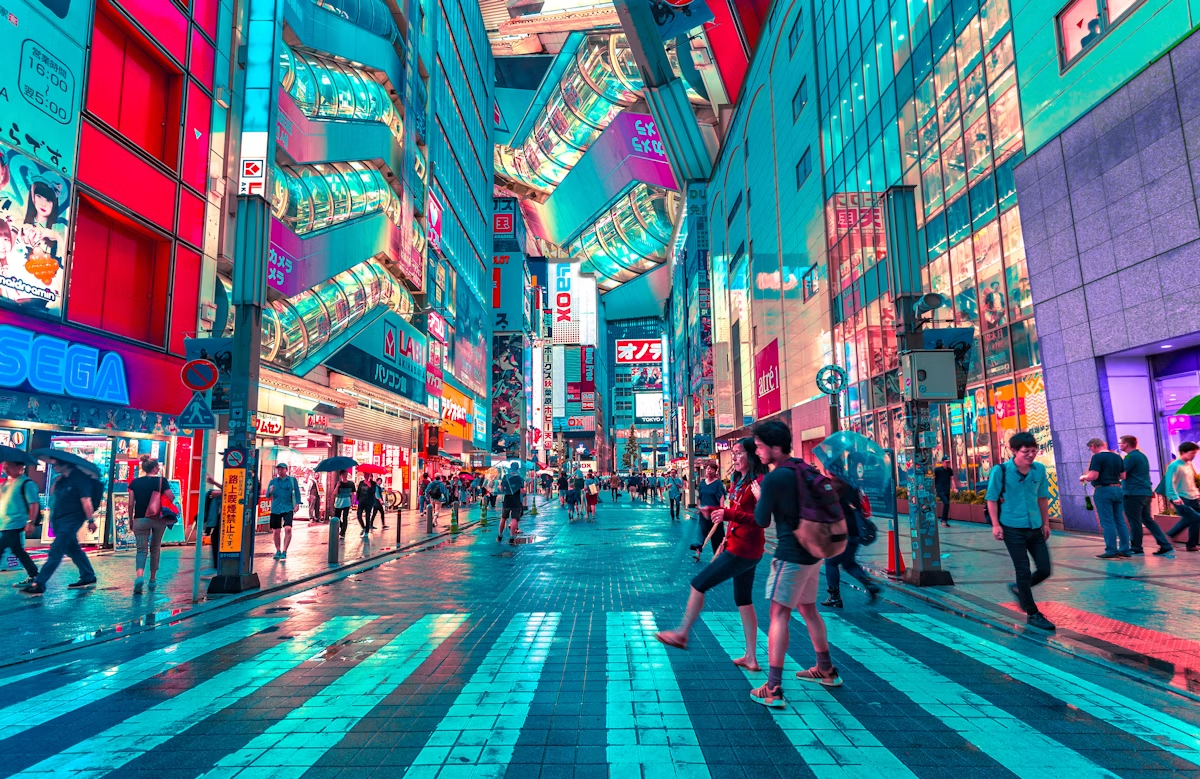
Akihabara: The global center of electronics and anime culture — six-story stores selling components, retro games, figurines, manga, and idol goods. The Electric Town discount corridors and the arcades with their eight floors of crane games form a unique urban ecosystem found nowhere else on earth.
Yanaka: The neighborhood that escaped both the 1923 earthquake and WWII bombing — wooden machiya townhouses, a functioning cemetery used as a park, independent craft shops, and cats. The least touristy face of old Tokyo, ten minutes from Ueno.
Senso-ji, Meiji, and the Temple Circuit
No Tokyo travel guide is complete without a structured approach to the city’s remarkable concentration of Shinto shrines and Buddhist temples, most free to enter and operating continuously since the 7th to 17th centuries.
Senso-ji (Asakusa): Tokyo’s oldest temple, founded 645 CE according to legend after two fishermen retrieved a golden Kannon statue from the Sumida River. The Kaminarimon (Thunder Gate) and its 670kg red lantern are the most photographed image in the city. Arrive before 7am for near-empty corridors; by 10am the Nakamise approach is dense with tourist groups.
Meiji Jingu (Harajuku): A Shinto shrine built in 1920 to honor Emperor Meiji and Empress Shoken, set within 70 hectares of forested grounds — a remarkable silence zone ten minutes’ walk from Harajuku Station. The sake barrel display and cypress torii gate are photographic landmarks.
Zojo-ji (Shiba): A 14th-century Jodo sect temple framed by Tokyo Tower — the most dramatic Buddhist-meets-modern-Tokyo composition in the city.
Nikko (day trip, 2 hrs): The Tosho-gu shrine complex in Nikko, dedicated to Tokugawa Ieyasu, founder of the Edo shogunate, is the most ornately decorated religious site in Japan — a UNESCO World Heritage Site of gold-leaf lacquerwork, carved animals (including the original “see no evil” monkeys), and cedar forest approached by a 2-kilometer avenue of 13,000 cryptomeria trees.
Day Trips from Tokyo
This Tokyo travel guide recommends at least one day trip outside the city — the surrounding Kanto region contains some of Japan’s most celebrated landscapes.
Mt. Fuji and Hakone (1.5–2 hrs by Romancecar express)
Hakone is the standard day-trip base for Mt. Fuji views — a volcanic hot spring (onsen) resort town accessible by Odakyu’s scenic Romancecar limited express (¥1,000 supplement over regular fare). The Open-Air Museum, the ropeway over Owakudani volcanic valley, and Lake Ashi with its torii rising from the water are the main draws. Mt. Fuji itself is only climbable from early July to early September; the Yoshida Trail ascent takes 5–7 hours.
Kamakura (1 hr by JR Yokosuka line)
A former feudal capital 50 kilometers south of Tokyo on Sagami Bay — a recommended stop in any Tokyo travel guide — home to the 13.35-meter Kotoku-in Daibutsu (Great Buddha, 1252 CE), eleven Zen temples including Engaku-ji and Kencho-ji, and the Daibutsu Hiking Trail connecting temples through forested ridgelines with Pacific Ocean views. ¥780 one way by JR Yokosuka Line from Tokyo Station (IC card accepted).
Nikko (2 hrs by Tobu Limited Express)
Covered above under temples; the full Tosho-gu complex requires 4–5 hours including the cryptomeria avenue walk, Rinno-ji temple, and the Futarasan Shrine. A Tobu Nikko Pass ($25–$35) covers round-trip train and two days of bus access within Nikko.
Kyoto (2 hrs 15 min by Shinkansen)
Technically a separate city but within practical day-trip distance via the Nozomi Shinkansen — every Tokyo travel guide recommends a 2-night extension (¥13,000 one way; not covered by JR Pass). Better as a 2-night extension to any Tokyo itinerary.
Food in Tokyo
Every Tokyo travel guide confronts the same opening challenge: where to begin in a city where a bowl of ramen at a standing counter can be as technically accomplished as a three-Michelin-star kaiseki meal, and both are worth your time.
Ramen: Tokyo-style shoyu (soy) ramen — thin straight noodles in a clear, complex chicken-soy broth — is the local variant. Ichiran, Fuunji, and Konjiki Hototogisu represent the range from chain to single-seat artisan. ¥900–¥1,500 per bowl. Many shops use ticket vending machines; point to the photo or default to the house recommendation.
Sushi: Tsukiji Outer Market (the external stalls after the wholesale market moved to Toyosu) remains the most accessible fresh sushi and seafood experience at fair prices; the Toyosu Market tuna auction requires advance lottery registration (free). Sushi Dai, Daiwa Sushi, and Sushi Zanmai in the Outer Market are worth the morning queues.
Tempura: The art of battering vegetables and seafood in icy, minimal batter and frying in sesame oil at precisely controlled temperatures. Tendon (tempura rice bowl) sets from ¥800 at local shops; kaiseki-level tempura restaurants in Ginza charge ¥8,000–¥30,000 for counter omakase.
Yakitori: Skewered chicken parts grilled over bincho charcoal — every cut from breast to cartilage to skin, with salt or tare glaze. The Yurakucho railway arches beneath the Yamanote Line between Tokyo and Yurakucho stations house some of the best standing yakitori stalls in the city (¥100–¥300 per skewer).
Convenience stores: 7-Eleven, FamilyMart, and Lawson in Japan are not convenience stores in any sense their name implies in other countries — they are functioning food operations producing fresh onigiri, hot steamed buns, multi-level bento boxes, sake, quality instant ramen, and usable coffee at ¥150–¥800 per item. Breakfast here is entirely reasonable.
Where to Stay
Budget (¥3,000–¥7,000/night)
Hostels in Asakusa, Ueno, and Shinjuku start from ¥2,800 for dorm beds; private rooms from ¥5,500. Capsule hotels — a genuinely comfortable experience with privacy pods, high-end shared bathrooms, and lounge areas — run ¥3,500–¥6,000 per night and are recommended at least once.
Mid-Range (¥10,000–¥25,000/night)
The standard Tokyo travel guide accommodation tier: business hotels (Dormy Inn, Sotetsu Fresa Inn, Tokyu REI Hotel) with compact, immaculately clean rooms and excellent breakfast buffets. Excellent value in Shinjuku, Shibuya, and Ginza.
Luxury (¥50,000–¥150,000+/night)
For travelers using this Tokyo travel guide to experience Japanese hospitality at its apex: the Park Hyatt (Lost in Translation hotel; ¥70,000–¥120,000), the Aman Tokyo (four floors of the Otemachi Tower; from ¥100,000), and the Mandarin Oriental (Nihonbashi; from ¥70,000). Each delivers the combination of peak service and architectural precision that defines Japanese luxury.
Getting Around Tokyo
The transit system is any Tokyo travel guide’s most frequent conversation starter — and this Tokyo travel guide addresses it, because it is simultaneously vast and completely intuitive once you have the IC card in your hand.
IC Card (Suica or Pasmo): A rechargeable contactless card loaded at any station machine (or via Apple/Google Pay). Touch in, touch out; automatically calculates the cheapest fare on any train, subway, bus, or tram in greater Tokyo. Also accepted at convenience stores, vending machines, and many restaurants. Load ¥3,000–¥5,000 for a 3-day visit.
JR Pass: A 7-day, 14-day, or 21-day unlimited Shinkansen and JR train pass purchased outside Japan. The 7-day pass ($275) is worth buying if you plan to travel Kyoto–Osaka–Hiroshima in addition to Tokyo. For Tokyo-only visits, the IC card is cheaper for all local travel.
Taxi: Expensive (starting at ¥500 plus ¥100 per 265 meters) and unnecessary given the rail network; useful late at night from Shinjuku or Shibuya after trains stop (approximately 12:30am).
Daily Budget Breakdown
The figures in this Tokyo travel guide reflect 2026 prices from a Shinjuku or Asakusa base.
| Category | Budget | Mid-Range | Luxury |
|---|---|---|---|
| Accommodation | ¥4,500 | ¥15,000 | ¥80,000 |
| Meals (3×) | ¥2,500 | ¥6,000 | ¥25,000 |
| Transport (IC) | ¥800 | ¥1,000 | ¥1,500 |
| Attractions | ¥500 | ¥2,500 | ¥10,000 |
| Daily Total | ~¥8,300 ($54) | ~¥24,500 ($158) | ~¥116,500 ($750) |
Japan Rail Pass vs. IC Card: The 2026 Decision
The JR Pass price increased significantly in 2023 and now costs more than it saves on Tokyo-only trips. A round trip Tokyo–Kyoto by Shinkansen (not covered) costs approximately ¥26,000 — meaning the 7-day Pass at ¥50,000 breaks even only if you add Osaka, Hiroshima, or Hakone. Use this Tokyo travel guide’s rule: if your trip goes beyond the Tokyo–Kyoto corridor, buy the Pass; if staying in greater Tokyo with day trips to Kamakura and Nikko, the IC card covers everything at lower cost.
Final Verdict: Tokyo Travel Guide 2026
Tokyo rewards longer stays — seven days is the minimum to begin feeling the rhythm of different neighborhoods, and fourteen days is ideal for combining the city with Kyoto, Hakone, and Kamakura without rushing. This Tokyo travel guide recommends arriving through Haneda rather than Narita for the shorter transfer, loading a Suica card before leaving the airport, and booking the most in-demand restaurants (particularly omakase sushi counters and standing ramen shops with long queues) at least 2–3 weeks in advance via TableCheck or the restaurant’s direct reservation system. Cherry blossom season (late March to mid-April) is the single most rewarding time to visit, but every hotel in the Tokyo travel guide budget table costs 30–50% more — book accommodation six months in advance for sakura season.