
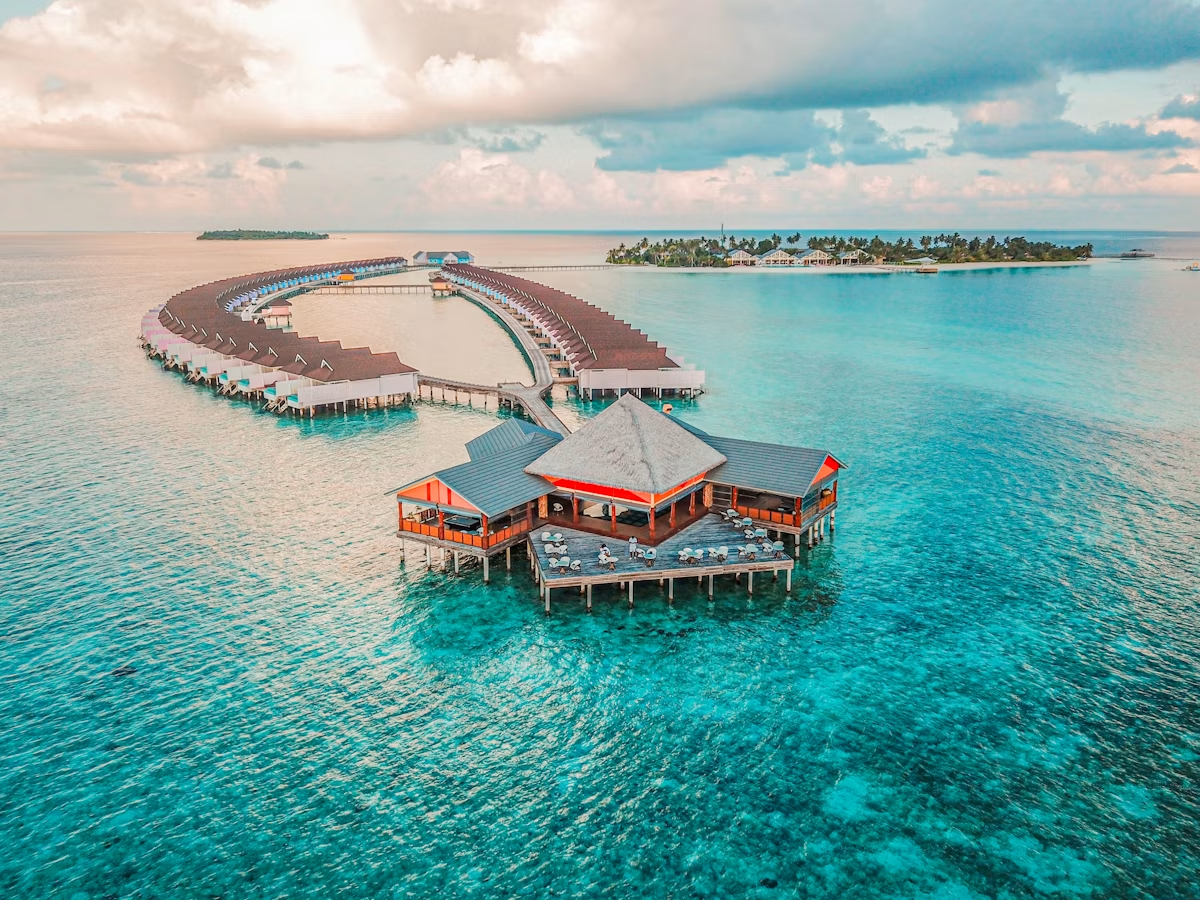
Maldives travel guide readers usually expect one category of visitor — the overwater bungalow couple on a honeymoon blowing $1,000 per night — and are surprised to discover an entirely separate budget travel circuit that uses local guesthouses on inhabited islands for $30–$60 per night, accesses the same reefs and sandbanks that luxury resorts charge a premium for, and eats fresh tuna curry at local cafés for $3 a plate. This Maldives travel guide covers both worlds: the ultra-luxury resort system (private islands, overwater villas, house reefs, seaplane transfers), and the local island guesthouse circuit (Maafushi, Thoddoo, Dhigurah) that has made the Maldives viable for budget travelers since the guesthouse regulation changed in 2009. The Maldives is an archipelago of 1,200 coral islands grouped into 26 atolls across 90,000 square kilometers of Indian Ocean — the most geographically dispersed country in the world — and the coral ecosystem beneath it is among the most biodiverse on earth.
At a Glance
| Country | Republic of Maldives |
| Currency | Maldivian Rufiyaa (MVR); $1 USD ≈ MVR 15.4; US dollars widely accepted |
| Language | Dhivehi; English widely spoken in tourism industry |
| Best time | November–April (dry season; clearest water visibility; calmest seas) |
| Avoid | May–October (southwest monsoon; rougher seas; some resorts offer lower rates) |
| Daily budget (guesthouse) | $60–$120/day |
| Daily budget (resort) | $400–$5,000+/day |
| Visa | Visa on arrival free for all nationalities (30 days) |
| Getting there | International flights to Velana International Airport (MLE), Malé; speedboat or seaplane to islands |
| Getting around | Public ferries (cheapest, slow); speedboat transfers ($20–$80 per sector); domestic flights; seaplanes |
The Atolls: Reef, Ocean, and Island Life
This Maldives travel guide organizes the destination by atoll rather than by region, because geography here is everything — the distance between your island and the experiences you want defines the entire trip.
Kaafu Atoll (North Malé): The most accessible atoll, encircling the capital Malé, and home to many major resorts reachable by 20–45-minute speedboat. Budget travelers base in Maafushi — the most developed local island with guesthouses, dive shops, sandbank excursions, and a bikini beach — for $35–$60 per night.
Ari Atoll (South & North): The most reef-rich atoll in the country — a key stop on any Maldives travel guide itinerary — famous for whale shark sightings year-round at South Ari and manta ray aggregations from May–November. A 25-minute domestic flight from Malé or a 2-hour speedboat transfer. Thoddoo island — a local island in North Ari growing watermelon and tropical fruits — offers guesthouses from $40/night within easy distance of the mantas.
Baa Atoll (UNESCO Biosphere Reserve): Home to Hanifaru Bay, one of the world’s great wildlife spectacles — a shallow bay where manta rays and whale sharks aggregate in the hundreds during the southwest monsoon (June–November). Access requires a domestic flight; the bay has strict entry limits (permit required for snorkeling, no diving). Several mid-range guesthouses operate on the local islands of Eydhafushi and Dharavandhoo.
Addu Atoll (southernmost): A 1-hour domestic flight from Malé; connected islands accessible by road, British colonial history, and far fewer tourists than northern atolls. Excellent for uncrowded diving and local culture.
Diving, Snorkeling, and Marine Life
No Maldives travel guide is complete without detailing what lies underwater — because the marine ecosystem is the entire reason to visit.
The Maldives sits within the Central Indian Ocean and is one of the world’s top ten dive destinations. House reefs extend from the edges of resort and local islands with walls, caves, and channels that host Napoleon wrasse, reef sharks, turtles, moray eels, and hundreds of species of reef fish. Snorkeling directly from the beach is possible at Maafushi, Thoddoo, Dhigurah, and most resort islands — no boat required.
Whale sharks: South Ari Atoll is the most reliable year-round whale shark location on earth; snorkeling alongside them is a standard daily excursion from local island guesthouses in the area ($30–$50 per person).
Manta rays: Baa Atoll (June–November), Ari Atoll (May–November), and North Malé Atoll (December–April) all produce manta aggregations at specific cleaning stations and feeding sites.
Night diving and bioluminescence: Several dive operators on local islands offer night dives over bioluminescent plankton; the beaches of Vaadhoo Island (Raa Atoll) are famous for bioluminescent waves at night.
Dive costs: Local island dive shops charge $55–$80 per two-tank dive; resort dive centers charge $100–$160. PADI Open Water certification courses cost $400–$600.
Day Trips and Excursions
This Maldives travel guide recommends booking excursions through local island operators rather than resort concierge desks — quality is identical and prices are 40–70% lower.
Sandbank Picnics
Private sandbanks — temporary white sand formations rising 30 centimeters above the waterline, surrounded by 360 degrees of turquoise ocean — are the definitive Maldives photograph. Day trips from Maafushi, Thoddoo, and Dhigurah include boat transfer, lunch, and snorkeling at $30–$60 per person.
Dolphin Cruises
Spinner dolphins follow speedboats through the channels between atolls at dawn and dusk; sunset dolphin cruises are the most popular daily excursion from every local island. $20–$35 per person.
Malé City Tour
The densely packed capital city — 200,000 people on a 2-square-kilometer island — contains the 17th-century Friday Mosque (Hukuru Miskiiy), the fish market at dawn, the National Museum (MVR 50 entry), and the new Sinamalé Bridge connecting Malé to the airport island. A half-day visit from Maafushi costs $15–$25 by public ferry.
Watervilla Day Pass
Several luxury resorts sell day passes ($100–$300 per person) allowing non-guests to use pools, beaches, restaurants, and sometimes water sports. Conrad Maldives, Baros, and Anantara Kihavah commonly offer these; book directly on resort websites.
Food in the Maldives
Every Maldives travel guide distinguishes between two food systems: resort dining (expensive, international, all-inclusive packages common) and local island dining (cheap, authentic, tuna-centric).
Maldivian cuisine revolves around tuna — specifically skipjack tuna (locally called “mas”) — combined with coconut, lime, and chili in forms ranging from mas huni (smoked tuna with grated coconut and onion, eaten for breakfast with roshi flatbread) to garudhiya (clear tuna broth served with rice, lime, and chili). A full local meal costs $3–$7 at cafés on Maafushi, Thoddoo, and Dhigurah.
- Mas huni: Shredded smoked tuna with coconut, onion, and chili — the national breakfast dish
- Garudhiya: Light tuna soup served with rice, lime, and fresh chili — the purest expression of Maldivian flavor
- Bajiyaa: Deep-fried tuna and coconut fritters — a street snack available at every local café
- Short eats (hedhikaa): A category of savory fried snacks served at tea time across all local islands
- Alcohol note: Alcohol is legal only at resort islands and live-aboard dive boats; local islands are alcohol-free under Maldivian law
Where to Stay
Budget — Local Island Guesthouses ($30–$80/night)
Maafushi is the most developed local island for tourism — multiple guesthouse blocks, dive shops, a bikini beach (swimwear permitted on a designated beach section), and regular speedboat connections. Standard rooms $35–$60/night.
Thoddoo (North Ari) is quieter, more rural, and excellent for manta encounters; guesthouses $30–$50/night. Dhigurah (South Ari) is a narrow sandbar island 3km long with whale shark excursions departing daily; guesthouses $40–$65/night.
Mid-Range Resorts ($200–$500/night)
The standard Maldives travel guide accommodation tier for resort stays — overwater bungalows and beach villas with house reef access, all-day dining, and included snorkeling equipment. Centara Ras Fushi, Adaaran Club Rannalhi, and Sun Siyam Olhuveli represent good value at this level.
Luxury Resorts ($800–$5,000+/night)
For travelers using this Maldives travel guide to plan a once-in-a-lifetime stay: Soneva Jani (private water slides into the lagoon; $1,200–$4,000/night), Gili Lankanfushi (the original luxury overwater bungalow resort; from $900/night), and Conrad Maldives Rangali Island (the world’s first underwater restaurant; from $1,100/night) represent the pinnacle of the category.
Getting Around
Getting between islands is the central logistics challenge, and any Maldives travel guide must answer it before arrival planning makes sense.
Speedboats: The fastest and most flexible option between Malé airport and local islands. Maafushi is 45 minutes ($10–$15 by shared speedboat); more distant atolls cost $50–$80 per sector. Schedules are fixed; book the day before.
Public ferries: The cheapest way to travel between islands in the same atoll ($1–$3 per journey), but frequency is low — typically once daily in the morning, returning in the afternoon. Recommended for long stays on local islands.
Domestic flights: Island Aviation Services connects Malé to domestic airports at Dharavandhoo (Baa Atoll), Maafaru (Noonu), Kadhdhoo (Laamu), and Gan (Addu). 40–75 minutes; $80–$180 one way.
Seaplanes: Trans Maldivian Airways operates the world’s largest seaplane fleet, transferring guests from Malé airport directly to resort jetties. Spectacular; typically included in resort packages; operates daylight hours only.
Daily Budget Breakdown
The figures in this Maldives travel guide reflect 2026 guesthouse and mid-range resort pricing.
| Category | Budget (Guesthouse) | Mid-Range (Resort) | Luxury (Resort) |
|---|---|---|---|
| Accommodation | $50 | $350 | $1,500 |
| Meals | $15 | $80 (half-board) | Included |
| Excursions | $40 | $60 | Included |
| Transfers | $15 | $80 (seaplane) | Included |
| Daily Total | ~$120 | ~$570 | ~$1,500+ |
Final Verdict: Maldives Travel Guide 2026
The Maldives travel guide that treats this destination as purely a luxury honeymoon product misses a genuinely accessible adventure travel circuit that has expanded significantly since 2015. Budget travelers who base on Thoddoo or Dhigurah and book dive excursions and sandbank trips independently can access the same whale sharks, mantas, and bioluminescent reefs that $1,500-per-night resorts market as their headline experiences — at a fraction of the cost. For resort stays, this Maldives travel guide recommends booking during the shoulder season (May, October, early November) when rates drop 30–50% and the diving is frequently spectacular despite the southwest monsoon. Book seaplane transfers and high-demand resort dates 4–6 months ahead; local island guesthouses can typically be booked 1–4 weeks out.